Design Approach
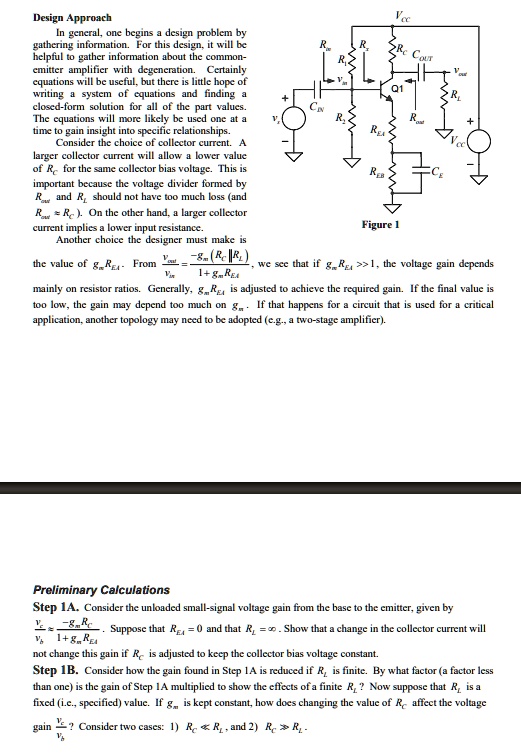
In general, one begins a design problem by
gathering information. For this design, it will be
helpful to gather information about the common-
emitter amplifier with degeneration. Certainly
equations will be useful, but there is little hope of
writing a system of equations and finding a
closed-form solution for all of the part values.
The equations will more likely be used one at a
time to gain insight into specific relationships.
Consider the choice of collector current. A
larger collector current will allow a lower value
of $R_E$ for the same collector bias voltage. This is
important because the voltage divider formed by
$R_1$ and $R_2$ should not have too much loss (and
$R_1 \approx R_2$). On the other hand, a larger collector
current implies a lower input resistance.
Another choice the designer must make is
the value of $g_m R_E$. From $\frac{V_{out}}{V_{in}} = \frac{-g_m (R_C || R_L)}{1 + g_m R_{EA}}$, we see that if $g_m R_{EA} >> 1$, the voltage gain depends
mainly on resistor ratios. Generally, $g_m R_E$ is adjusted to achieve the required gain. If the final value is
too low, the gain may depend too much on $g_m$. If that happens for a circuit that is used for a critical
application, another topology may need to be adopted (e.g., a two-stage amplifier).
Preliminary Calculations
Step 1A. Consider the unloaded small-signal voltage gain from the base to the emitter, given by
$\frac{V_c}{V_b} = \frac{-g_m R_C}{1 + g_m R_{EA}}$. Suppose that $R_{EA} = 0$ and that $R_L = \infty$. Show that a change in the collector current will
not change this gain if $R_C$ is adjusted to keep the collector bias voltage constant.
Step 1B. Consider how the gain found in Step 1A is reduced if $R_L$ is finite. By what factor (a factor less
than one) is the gain of Step 1A multiplied to show the effects of a finite $R_L$? Now suppose that $R_L$ is a
fixed (i.e., specified) value. If $g_m$ is kept constant, how does changing the value of $R_C$ affect the voltage
gain? Consider two cases: 1) $R_C << R_L$, and 2) $R_C >> R_L$.