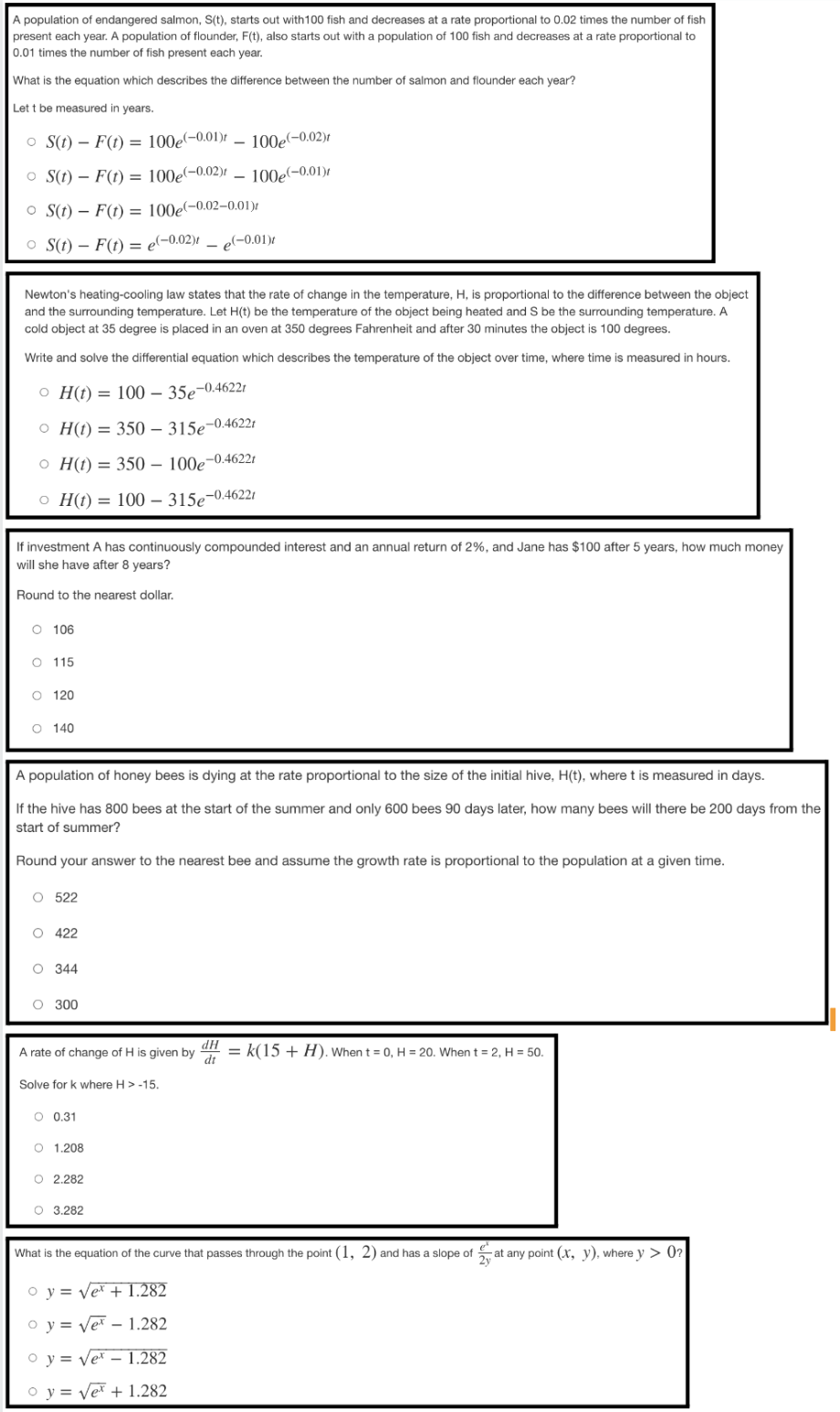
A population of endangered salmon, S(t), starts out with 100 fish and decreases at a rate proportional to 0.02 times the number of fish present each year. A population of flounder, F(t), also starts out with a population of 100 fish and decreases at a rate proportional to 0.01 times the number of fish present each year.
What is the equation which describes the difference between the number of salmon and flounder each year?
Let t be measured in years.
S(t) - F(t) = 100e^(-0.01)t - 100e^(-0.02)t
S(t) - F(t) = 100e^(-0.02)t - 100e^(-0.01)t
S(t) - F(t) = 100e^(-0.02-0.01)t
S(t) - F(t) = e^(-0.02)t - e^(-0.01)t
Newton's heating-cooling law states that the rate of change in the temperature, H, is proportional to the difference between the object and the surrounding temperature. Let H(t) be the temperature of the object being heated and S be the surrounding temperature. A cold object at 35 degree is placed in an oven at 350 degrees Fahrenheit and after 30 minutes the object is 100 degrees.
Write and solve the differential equation which describes the temperature of the object over time, where time is measured in hours.
H(t) = 100 - 35e^-0.4622t
H(t) = 350 - 315e^-0.4622t
H(t) = 350 - 100e^-0.4622t
H(t) = 100 - 315e^-0.4622t
If investment A has continuously compounded interest and an annual return of 2%, and Jane has $100 after 5 years, how much money will she have after 8 years?
Round to the nearest dollar.
106
115
120
140
A population of honey bees is dying at the rate proportional to the size of the initial hive, H(t), where t is measured in days.
If the hive has 800 bees at the start of the summer and only 600 bees 90 days later, how many bees will there be 200 days from the start of summer?
Round your answer to the nearest bee and assume the growth rate is proportional to the population at a given time.
522
422
344
300
A rate of change of H is given by dH/dt = k(15 + H). When t = 0, H = 20. When t = 2, H = 50.
Solve for k where H > -15.
0.31
1.208
2.282
3.282
What is the equation of the curve that passes through the point (1, 2) and has a slope of e^x / 2y at any point (x, y), where y > 0?
y = sqrt(e^x + 1.282)
y = sqrt(e^x) - 1.282
y = sqrt(e^x - 1.282)
y = sqrt(e^x) + 1.282