A beam of particles of N particles of mass m and momentum p has a wave function spread over a large
length L,
?p(x) = \frac{e^{ipx/h}}{\sqrt{L}}
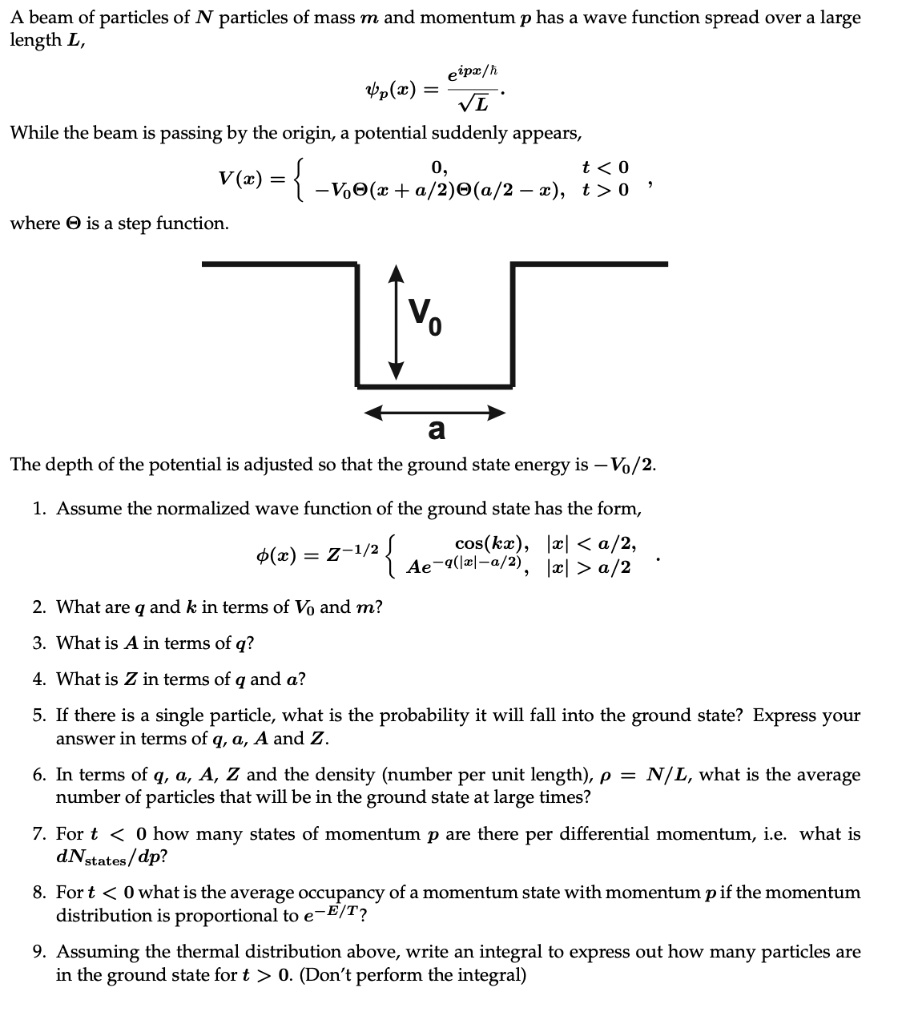
While the beam is passing by the origin, a potential suddenly appears,
V(x) = \begin{cases} 0, & t < 0\\ -V_0\Theta(x + a/2)\Theta(a/2 - x), & t > 0,\end{cases}
where \Theta is a step function.
The depth of the potential is adjusted so that the ground state energy is - V_0/2.
1. Assume the normalized wave function of the ground state has the form,
?(x) = Z^{-1/2} \begin{cases} \cos(kx), & |x| < a/2,\\ Ae^{-q(|x|-a/2)}, & |x| > a/2\end{cases} .
2. What are q and k in terms of V_0 and m?
3. What is A in terms of q?
4. What is Z in terms of q and a?
5. If there is a single particle, what is the probability it will fall into the ground state? Express your
answer in terms of q, a, A and Z.
6. In terms of q, a, A, Z and the density (number per unit length), p = N/L, what is the average
number of particles that will be in the ground state at large times?
7. For t < 0 how many states of momentum p are there per differential momentum, i.e. what is
dN_{states}/dp?
8. For t < 0 what is the average occupancy of a momentum state with momentum p if the momentum
distribution is proportional to e^{-E/T}?
9. Assuming the thermal distribution above, write an integral to express out how many particles are
in the ground state for t > 0. (Don't perform the integral)