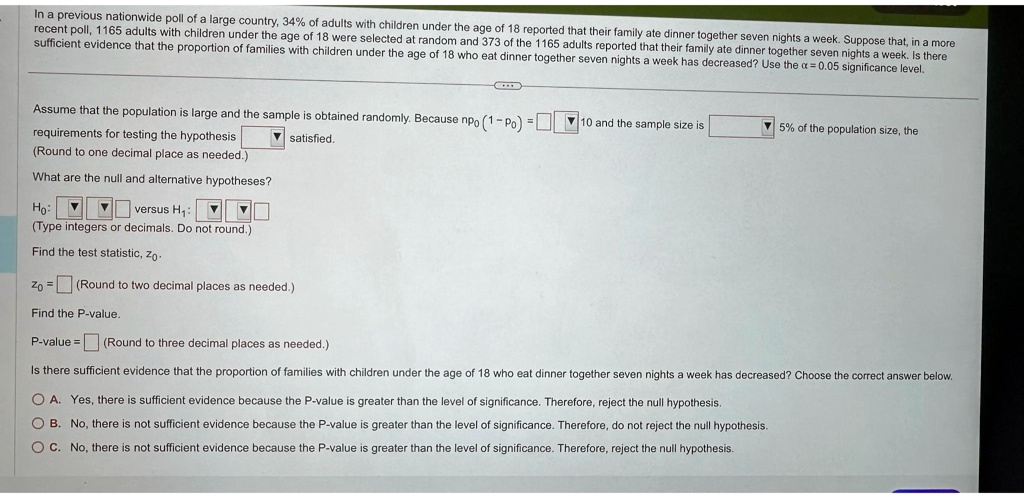
In a previous nationwide poll of a large country, 34% of adults with children under the age of 18 reported that their family ate dinner together seven nights a week. Suppose that, in a more
recent poll, 1165 adults with children under the age of 18 were selected at random and 373 of the 1165 adults reported that their family ate dinner together seven nights a week. Is there
sufficient evidence that the proportion of families with children under the age of 18 who eat dinner together seven nights a week has decreased? Use the $\alpha = 0.05$ significance level.
Assume that the population is large and the sample is obtained randomly. Because $n p_0 (1 - p_0) = \boxed{}$ $\boxed{>}$ 10 and the sample size is $\boxed{}$ $\boxed{<}$ 5% of the population size, the
requirements for testing the hypothesis $\boxed{}$ $\boxed{\text{are}}$ satisfied.
(Round to one decimal place as needed.)
What are the null and alternative hypotheses?
$H_0: \boxed{}$ $\boxed{}$ $\boxed{}$ versus $H_1: \boxed{}$ $\boxed{}$ $\boxed{}$
(Type integers or decimals. Do not round.)
Find the test statistic, $z_0$.
$z_0 = \boxed{}$ (Round to two decimal places as needed.)
Find the P-value.
P-value $= \boxed{}$ (Round to three decimal places as needed.)
Is there sufficient evidence that the proportion of families with children under the age of 18 who eat dinner together seven nights a week has decreased? Choose the correct answer below.
A. Yes, there is sufficient evidence because the P-value is greater than the level of significance. Therefore, reject the null hypothesis.
B. No, there is not sufficient evidence because the P-value is greater than the level of significance. Therefore, do not reject the null hypothesis.
C. No, there is not sufficient evidence because the P-value is greater than the level of significance. Therefore, reject the null hypothesis.