Ace - AI Tutor
Ask Our Educators
Textbooks
My Library
Flashcards
Scribe - AI Notes
Notes & Exams
Download App
savannah miller

savannah m.

Divider

Questions asked

BEST MATCH

If G is a nite group with fewer than 100 elements and G has subgroups of orders 10 and 25, what is the order of G?

View Answer
divider
BEST MATCH

6. Reaction conditions play a crucial role in determining the products of substitution and elimination reactions. Predict the major product for each of the following reactions, carefully considering the starting material and reaction conditions. For each case, evaluate the three possible pathways: $S_N1$, $S_N2$, and E2. Ignore the formation of E1 products. a) $\text{NaOCH}_3$ $\text{HOCH}_3$ $\xrightarrow{\text{KOtBu}}$ $\text{HOtBu}$ b) $\text{NaOCH}_3$ $\text{HOCH}_3$ $\Delta$ c) $\text{NaOCH}_3$ $\text{HOCH}_3$ $\Delta$ d) $\text{NaOCH}_3$ $\text{HOCH}_3$ $\Delta$ $\text{NaOCH}_3$ $\text{HOCH}_3$

View Answer
divider
BEST MATCH

(2) Which one of the following is TRUE about Bulk Modulus of elasticity? (A) it is the ratio of compressive stress to volumetric strain (B) it is the ratio of compressive stress to linear strain (C) it is the ratio of tensile stress to volumetric strain (D) it is the ratio of tensile stress to linear strain

View Answer
divider
BEST MATCH

For this week's discussion, you are asked to generate a continuous and differentiable function $f(x)$ with the following properties: • $f(x)$ is decreasing at $x = -5$ • $f(x)$ has a local minimum at $x = -3$ • $f(x)$ has a local maximum at $x = 3$ Your classmates may have different criteria for their functions, so in your initial post in Brightspace be sure to list the criteria for your function. Hints: • Use calculus! • Before specifying a function $f(x)$, first determine requirements for its derivative $f'(x)$. For example, one of the requirements is that $f'(-3) = 0$. • If you want to find a function $g(x)$ such that $g(-9) = 0$ and $g(8) = 0$, then you could try $g(x) = (x + 9)(x - 8)$. • If you have a possible function for $f'(x)$, then use the techniques in Indefinite Integrals this Module to try a possible $f(x)$.

View Answer
divider
BEST MATCH

what if the new molarity of a 0.750 solution of NaCl if 50.0 of it diluted to 150

View Answer
divider
BEST MATCH

Suppose the government decides to subsidize flu vaccinations in attempt to correct a market failure without this government intervention the flu vaccination will most likely be blank due to the presence of blank

View Answer
divider
BEST MATCH

On the day you retire you have $500,000 saved. You expect to live another 30 years during which time you expect to earn 8% on your savings while inflation averages 3.5% annually. Assume you want to spend the same amount each year in real terms and die on the day you spend your last dime. What real amount will you be able to spend each year? a. $61,931.78 b. $30,695.77 c. $79,644.58 d. $79,211.09

View Answer
divider
BEST MATCH

If a minivan averages 23.8 miles per gallon, how many miles will it travel on 22 gallons of gas?

View Answer
divider
BEST MATCH

Find the limits, if it exists. If a limit does not exist, state that fact.\\ $\lim_{x \to 3} \frac{x^2 - 9}{x - 3}$

View Answer
divider
BEST MATCH

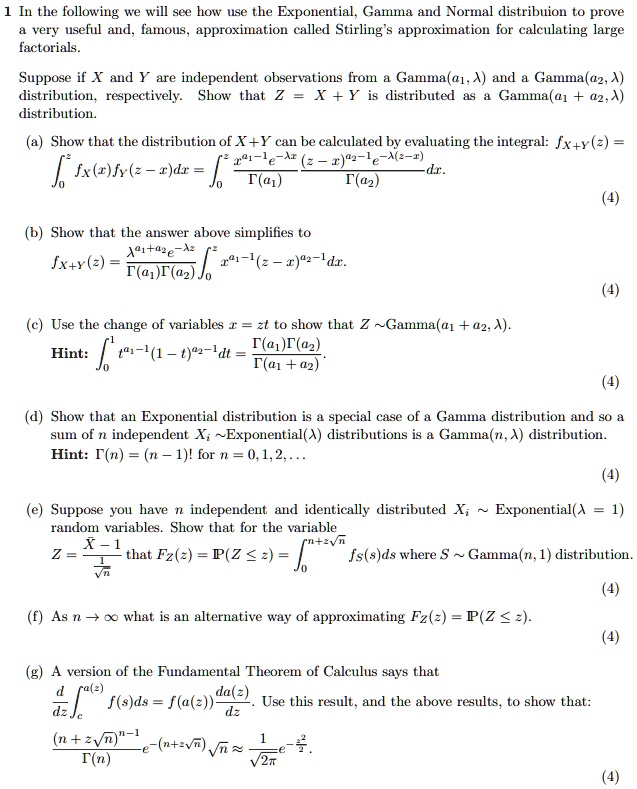
In the following, we will see how to use the Exponential, Gamma, and Normal distributions to prove a very useful and famous approximation called Stirling's approximation for calculating large factorials. Suppose X and Y are independent observations from a Gamma(1, ) and a Gamma(2, ) distribution, respectively. Show that Z = X + Y is distributed as a Gamma(a + a, ) distribution. (a) Show that the distribution of X + Y can be calculated by evaluating the integral: f(x+y)(z) = 2^(x-1)e^(-Xx)(z-x)^(a-1)e^(-x)(-x) f(x)f(y(z-x))dx = dx. r(a) T(a^2) (4) (b) Show that the answer above simplifies to 1 + a^2e^(-Xz) f(x+y)(z) = x^(P-2)(x-2-1X) r(a)I(a^2)Jo (4) (c) Use the change of variables z = t to show that Z ~ Gamma(a + 2, A) - I(aT(a^2) Hint: 1/(a1+a2) (4) (d) Show that an Exponential distribution is a special case of a Gamma distribution and so a sum of n independent X; Exponential() distributions is a Gamma(n, A) distribution. Hint: T(n) = (n-1)! for n = 0, 1, 2,... (4) (e) Suppose you have n independent and identically distributed X; Exponential = 1 random variables. Show that for the variable n+2/n f(s)(s)ds where S ~ Gamma(n, 1) distribution Vn (4) (f) As n -> infinity, what is an alternative way of approximating F(z) = P(Z < z) (4) (g) A version of the Fundamental Theorem of Calculus says that dz Jc (n + z/n)^(n-1) I(n) V2T (4)
View Answer
divider