Ace - AI Tutor
Ask Our Educators
Textbooks
My Library
Flashcards
Scribe - AI Notes
Notes & Exams
Download App
scott barroso

scott b.

Divider

Questions asked

BEST MATCH

1. (5 points) A normally distributed random variable has density function $$f(y) = \frac{1}{\sigma\sqrt{2\pi}}e^{-\frac{(y-\mu)^2}{2\sigma^2}}, y \in R$$. Using the fundamental properties associated with any density function, argue that the parameter $\sigma > 0$.

View Answer
divider
BEST MATCH

Is it ethical to report a personal loan on accounts recievable when borrowing money from a business

View Answer
divider
BEST MATCH

The United Kingdom colonized over one quarter of the globe. The reason it was able to do so was because: Group of answer choices A large population Significant oil reserves A wealth of gold mines A powerful navy

View Answer
divider
BEST MATCH

Find the derivative of the function $w = (t^6 + 1)^{49}$.

View Answer
divider
BEST MATCH

Problems 44 & 45 are linked 44. In a particular experiment to determine the index of refraction, n of a material, the following equation is derived: sin( heta _(1))=nsin( heta _(2)). What should be plotted (y vs. x ) to determine the index of refraction? What would be the associated slope and intercept of the graph? 45. LINEST from excel gives a slope of S=1.34+-0.06. Calculate and report the index of refraction with uncertainty. What are its units? Based on the reported value for the index of refraction, what material might it be? Problems 44 & 45 are linked 44. In a particular experiment to determine the index of refraction, n of a material, the following equation is derived: sin(01) = n sin(02).What should be plotted (y vs. x) to determine the index of refraction? What would be the associated slope and intercept of the graph? 45. LINEST from excel gives a slope of S - 1.34 + 0.06.Calculate and report the index of refraction with uncertainty. What are its units? Based on the reported value for the index of refraction, what material might it be?

View Answer
divider
BEST MATCH

Problem 3 (25 points) Consider a damped harmonic oscillator of mass $m$ experiencing a linear restoring force ($-kx$) and a damping force proportion to its speed ($-bv$). (a) Use Newton's 2nd Law to write the equation of motion (i.e., $\sum F = m\ddot{x}$) for this oscillator. To receive full credit, you must draw a free-body diagram. Be sure to include a coordinate system and clearly label all forces acting on the mass. (b) Using the equation of motion from in part (a), determine the corresponding solutions $x(t)$ representing the underdamped, critically damped, and overdamped motions. To receive full credit, you must fully develop/derive each expression. (c) Assuming that the damping parameter for this oscillator is $\beta = \omega_0/2$, determine the corresponding solution for the oscillator's position as a function of time $x(t)$. (d) The damped oscillator is now acted upon by a driving force of $F = F_0 \cos \omega t$. Determine the new equation of motion and its corresponding solution $x(t)$. To receive full credit, you must determine all of the constants (e.g., $A_1$, $A_2$, $B_1$, $B_2$, etc.).

View Answer
divider
BEST MATCH

Language Recognition THEOREM 2 states that a set is generated by a regular grammar if and only if it is a regular set. Let G be the regular grammar G = (V, T, S, P), where V = \{0, 1, A, S\}, T = \{0, 1\}, and the productions in P are S \to 1A, S \to 0, A \to 0A, A \to 1. Construct a finite-state automaton that recognizes the language generated by G.

View Answer
divider
BEST MATCH

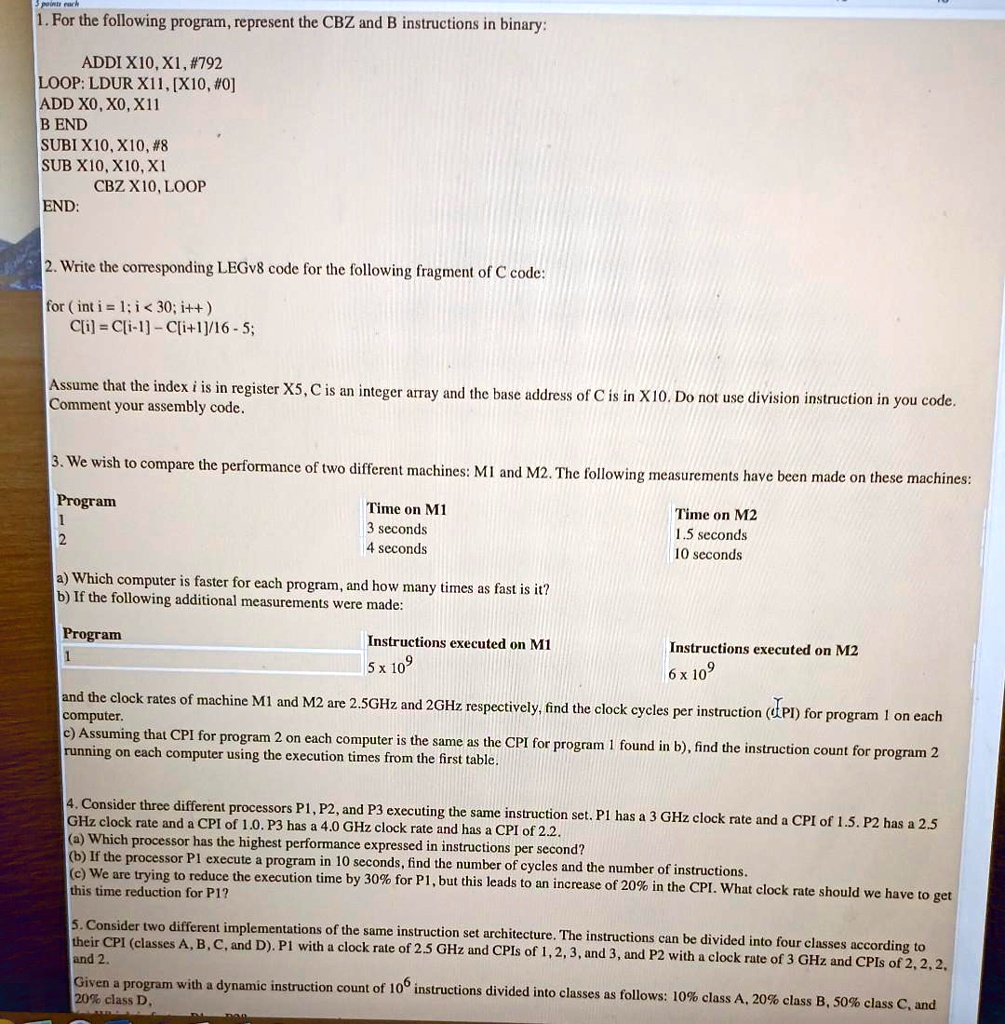
For the following program, represent the CBZ and B instructions in binary: ADDI X10, X1, #792 LOOP: LDUR X11, [X10, #0] ADD X0, X0, X11 B END SUBI X10, X10, #8 SUB X10, X10, X1 CBZ X10, LOOP END: Write the corresponding LEGv8 code for the following fragment of C code: for(int i=1; i<30; i++) { C[i] = C[i-1] - C[i+1]/16 - 5; } Assume that the index i is in register X5, C is an integer array, and the base address of C is in X10. Do not use division instruction in your code. Comment your assembly code. We wish to compare the performance of two different machines: MI and M2. The following measurements have been made on these machines: Program Time on M1 Time on M2 1 2 seconds 1.5 seconds 2 4 seconds 10 seconds a) Which computer is faster for each program, and how many times as fast is it? b) If the following additional measurements were made: Program Instructions executed on MI: 5x10^9 Instructions executed on M2: 6x10^9 and the clock rates of machine M1 and M2 are 2.5GHz and 2GHz respectively, find the clock cycles per instruction (CPI) for program I on each computer. c) Assuming that CPI for program 2 on each computer is the same as the CPI for program 1 found in b, find the instruction count for program 2 running on each computer using the execution times from the first table. Consider three different processors P1, P2, and P3 executing the same instruction set. P1 has a 3 GHz clock rate and a CPI of 1.5. P2 has a 2.5 GHz clock rate and a CPI of 1.0. P3 has a 4.0 GHz clock rate and has a CPI of 2.2. b) If the processor P1 executes a program in 10 seconds, find the number of cycles and the number of instructions. What is the time reduction for P1? Consider two different implementations of the same instruction set architecture. The instructions can be divided into four classes according to and2. 20% class D
View Answer
divider
BEST MATCH

Moving to the next question prevents changes to this answer. Question 2 An advance received from a customer should be recorded as: An increase in cash due to receiving the deposit An increase in a liability for unearned revenue Both of the above None of the above ?Moving to the next question prevents changes to this answer.

View Answer
divider
BEST MATCH

Text: Type the following C program. This is a sample program for getting process ID and forking a separate process: #include <stdio.h> #include <sys/types.h> int main(void) { int i; printf("FORK TEST PROGRAM\n"); printf("My process id %d and My Parent's process id %d\n", getpid(), getppid()); i = fork(); /* A child process is created and the codes are the same */ if (i == -1) { printf("How many times do you SEE this line?\n"); printf("Process cannot be created\n"); exit(0); } if (i != 0) { /* parent process executes */ printf("PARENT: I am the parent - My process id %d and My Parent's process id %d\n", getpid(), getppid()); printf("PARENT: My child process id is %d\n", i); } else { /* Child process continues here. the value that is returned is 0 */ printf("CHILD: I am the child - My process id %d and My Parent's process id %d\n", getpid(), getppid()); } exit(0); } Call the above program p2.c, and compile it as follows: gcc -o p2 p2.c <Enter>. Then execute p2 and report the output. Questions: 2.1 How many times fork() system call returns in this program? Explain your answer? 2.2 What is the return value of fork() system call? 2.3 What is the parent process ID? 2.4 What is the child process ID? 2.5 What is the parents’ parent process ID? 2.6 How many times do you see the "How many times do you see this line?" message? Why? 3. The only way in which a program is executed by UNIX is for an existing process to issue the exec() system call. The exec() system call replaces the current process with the new program. The process ID does not change. Some UNIX manuals incorrectly refer to the new program as the new process, but realize that it is really a new program executing in the context of the calling process. A new process is not created by exec(). There are six versions of exec system call: execlp, execl, execle, execvp, execv, execve. Here, we are using the execvp(file, argv). This is argv style with automatic searching, containing the pointers to the argument strings. This argv array must contain a NULL pointer to specify its end, since a count is not specified.

View Answer
divider