Ace - AI Tutor
Ask Our Educators
Textbooks
My Library
Flashcards
Scribe - AI Notes
Notes & Exams
Download App
scott cooper

scott c.

Divider

Questions asked

BEST MATCH

What is step one of the three-step process for computing net cash provided by operating activities? multiple choice 2 Add depreciation Adjust for gains/losses Analyze net changes in noncash balance sheet accounts Subtract dividends

View Answer
divider
BEST MATCH

\[ \log (P)=\log (c)-k \log (W) \] where \( W \) is the wealth level (how much money a person has) and \( P \) is the number of people in the population having that much money. (a) Solve the equation for \( P \) : \[ \boldsymbol{P}=\square \] (b) Assume \( k=2.1, c=8000 \), and \( W \) is measured in millions of dollars. Use part (a) to find the number of people who have \( \$ 2 \) million or me whole number.) \( \square \) people How many people have \( \$ 10 \) million or more? (Round your answer to the nearest whole number.) \( \square \) people Submit Answer

View Answer
divider
BEST MATCH

The geometric mean proportion of 2 and 32 is: a. 16 b. 17 c. 8 d. 18

View Answer
divider
BEST MATCH

\[ A=\lim _{x \rightarrow-2} \frac{|x+2|}{x+2} \] Select one: a. \( \infty \) b. DNE c. -1 d. 1

View Answer
divider
BEST MATCH

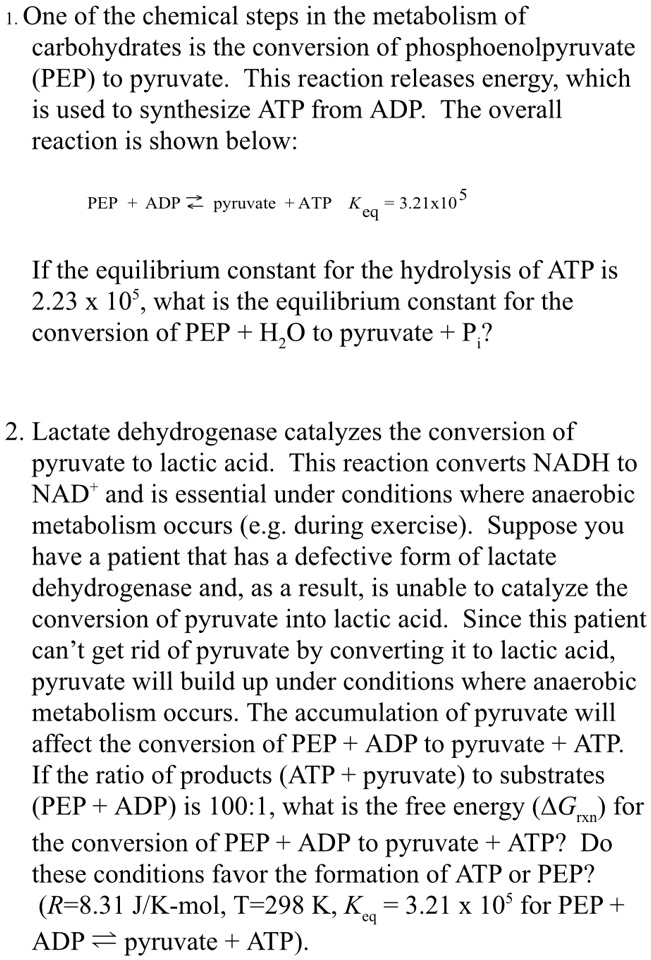
1. One of the chemical steps in the metabolism of carbohydrates is the conversion of phosphoenolpyruvate (PEP) to pyruvate. This reaction releases energy, which is used to synthesize ATP from ADP. The overall reaction is shown below: PEP + ADP $\rightleftharpoons$ pyruvate + ATP $K_{eq}$ = 3.21x10⁵ If the equilibrium constant for the hydrolysis of ATP is 2.23 x 10⁵, what is the equilibrium constant for the conversion of PEP + H₂O to pyruvate + P₁? 2. Lactate dehydrogenase catalyzes the conversion of pyruvate to lactic acid. This reaction converts NADH to NAD⁺ and is essential under conditions where anaerobic metabolism occurs (e.g. during exercise). Suppose you have a patient that has a defective form of lactate dehydrogenase and, as a result, is unable to catalyze the conversion of pyruvate into lactic acid. Since this patient can't get rid of pyruvate by converting it to lactic acid, pyruvate will build up under conditions where anaerobic metabolism occurs. The accumulation of pyruvate will affect the conversion of PEP + ADP to pyruvate + ATP. If the ratio of products (ATP + pyruvate) to substrates (PEP + ADP) is 100:1, what is the free energy (ΔG<sub>rxn</sub>) for the conversion of PEP + ADP to pyruvate + ATP? Do these conditions favor the formation of ATP or PEP? (R=8.31 J/K-mol, T=298 K, K<sub>eq</sub> = 3.21 x 10⁵ for PEP + ADP $\rightleftharpoons$ pyruvate + ATP).
View Answer
divider
BEST MATCH

Use either Gaussian elimination or Gauss-Jordan elimination to solve the given system or show that no solution exists. (If there is no solution, enter NO SOLUTION. If the system has an infinite number of solutions, use t for the parameter.) $$9x_1 + 3x_2 = -2$$ $$2x_1 + x_2 = -1$$ $$(x_1, x_2) =$$

View Answer
divider
BEST MATCH

Negative intrapleural pressure

View Answer
divider
BEST MATCH

Find the derivative of: $-7\sqrt{x} - \frac{3}{x^4}$

View Answer
divider
BEST MATCH

Write the balanced equation, then outline the steps necessary to determine the information requested. Answer to 3 significant figures. H H H H The number of moles and the mass of C=C required to react with $H_2O$ to produce 9.55 g of H-C-C-O-H. H Upload your steps here: Choose File No file chosen Determine the number of moles and the mass requested for the reaction. Moles $C_2H_4$: Mass $C_2H_4$: g HH

View Answer
divider
BEST MATCH

The mass (m) of a piece of metal is directly proportional to its volume (V), where the proportionality constant is the density (D) of the metal. a. Choose the equation that represents this direct proportion, in which D is the proportionality constant. m = D \times V D = \frac{m}{V} V = \frac{m}{D} b. What is the mass of a piece of chromium metal that has a volume of 24.6 cm$^3$? (The density of chromium metal is 7.25 g/cm$^3$.) Mass = g c. What is the volume of a piece of chromium metal that has a mass of 180 g? Volume = cm$^3$

View Answer
divider