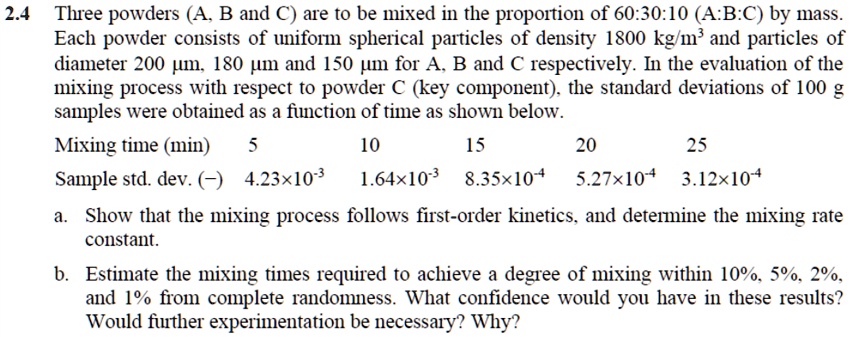
2.4 Three powders (A, B and C) are to be mixed in the proportion of 60:30:10 (A:B:C) by mass.
Each powder consists of uniform spherical particles of density 1800 kg/m³ and particles of
diameter 200 µm, 180 µm and 150 µm for A, B and C respectively. In the evaluation of the
mixing process with respect to powder C (key component), the standard deviations of 100 g
samples were obtained as a function of time as shown below.
Mixing time (min)
5
10
15
20
25
Sample std. dev. (-)
4.23×10?³
1.64×10?³
8.35×10??
5.27×10??
3.12×10??
a. Show that the mixing process follows first-order kinetics, and determine the mixing rate
constant.
b. Estimate the mixing times required to achieve a degree of mixing within 10%, 5%, 2%,
and 1% from complete randomness. What confidence would you have in these results?
Would further experimentation be necessary? Why?