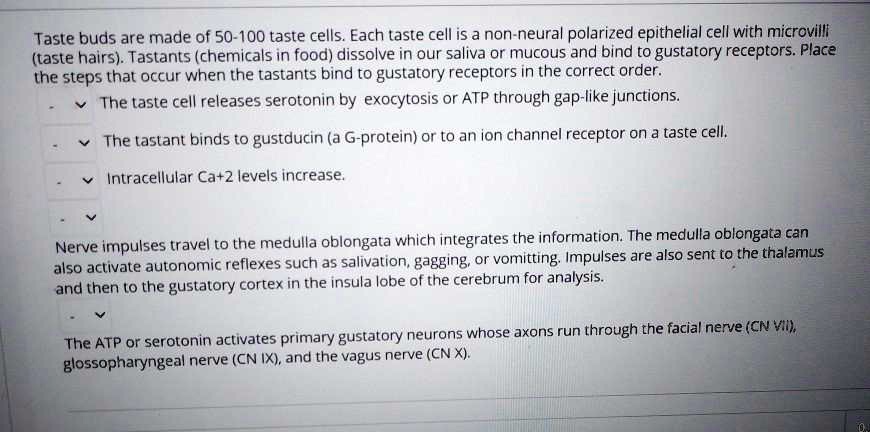
Taste buds are made of 50-100 taste cells. Each taste cell is a non-neural polarized epithelial cell with microvilli
(taste hairs). Tastants (chemicals in food) dissolve in our saliva or mucous and bind to gustatory receptors. Place
the steps that occur when the tastants bind to gustatory receptors in the correct order.
The taste cell releases serotonin by exocytosis or ATP through gap-like junctions.
The tastant binds to gustducin (a G-protein) or to an ion channel receptor on a taste cell.
Intracellular Ca+2 levels increase.
Nerve impulses travel to the medulla oblongata which integrates the information. The medulla oblongata can
also activate autonomic reflexes such as salivation, gagging, or vomitting. Impulses are also sent to the thalamus
and then to the gustatory cortex in the insula lobe of the cerebrum for analysis.
The ATP or serotonin activates primary gustatory neurons whose axons run through the facial nerve (CN VII),
glossopharyngeal nerve (CN IX), and the vagus nerve (CN X).