Questions asked
What is the amortized time complexity of the push_back operation discussed in slides, given a vector of size n? Group of answer choices Θ(1) Θ(log n) Θ(n) Θ(n2)
selevione \( \square \) 00.8333 .33 natefera pet hour: \( 19004000 a c t e j a b e r n o u r \) ?
Find the exact value of $1 - 2\sin^2\left(\frac{5\pi}{8}\right)$ without using a calculator. Show your work.
(?)
The figure below shows a randomization distribution based on 1000 simulated samples for testing \( H_{0}: \mu=50 \mathrm{vs} \) \( H_{a}: \mu>50 \). In each case, use the distribution to decide which value is closer to the \( p \)-value for the observed sample mean. (a) The p-value for \( \bar{x}=66 \) is closest to: 0.02 or 0.23 ? \( \square \) (b) The \( p \)-value for \( \bar{x}=55 \) is closest to: 0.11 or 0.29 ? \( \square \) (c) The p-value for \( \bar{x}=63 \) is closest to: 0.06 or 0.47 ?
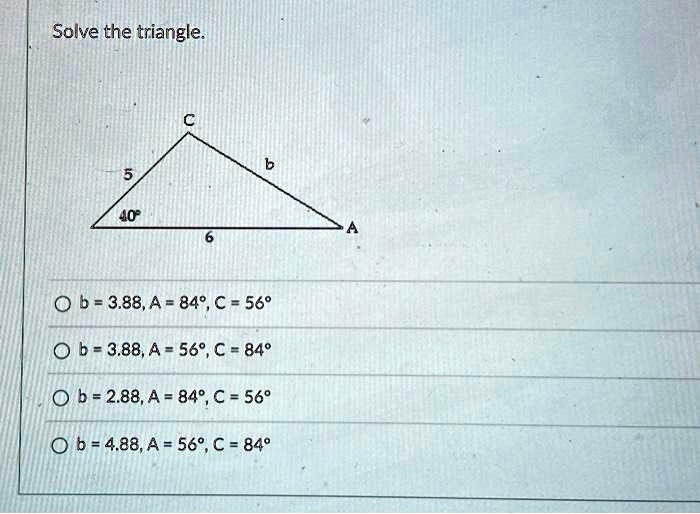
Solve the triangle. C b 5 40° 6 ? b = 3.88, A = 84°, C = 56° b=3.88, A = 56°, C = 84° b=2.88, A = 84°, C = 56° b=4.88, A = 56°, C = 84° A
Select all that apply Which of the following statements are TRUE for coding prolonged services? Multiple select question. To determine the most accurate code from this subcategory, you need to identify the situation for the Prolonged services. Prolonged services must be coded in addition to standard E/M codes. Prolonged services are broken into three categories. Time spent while providing other services, procedures, or treatments which are reported by codes other than E/M is included in the calculation for prolonged service.
Is the following tree a min-heap? (Why?) 5 / 15 20 / 18 30 25 / / 32 78 28
A student prepares 675.0 mL of 0.350 M KCl for an experiment. However, they accidentally spill 95.0 mL of pure water into the KCl solution. What is the new molar concentration of KCl after the spill?
to n. It does this by enumerating an iterable object of type Primes (also defined in Primes.java) using an enhanced for loop and keeping track of the number of primes encountered. This is how the program is expected to run: $ java Primes 10 # of primes <= 10 = 4 $ java Primes 100 # of primes <= 100 = 25 $ java Primes 1000 # of primes <= 1000 = 168