Ace - AI Tutor
Ask Our Educators
Textbooks
My Library
Flashcards
Scribe - AI Notes
Notes & Exams
Download App
sebastian yuste

sebastian y.

Divider

Questions asked

BEST MATCH

An analysis of future events performed by the probability of those events and the potential outcomes is called ________blank.

View Answer
divider
BEST MATCH

blank contains each variable in the study and specifies the application of mappingrules to the response codes of each variable. A.Instrument disposition instructions B. A coding Scheme C.A survey time frame D. A data Field E. Data Entry

View Answer
divider
BEST MATCH

Which of the following is/are limitations of participant observation? It requires the use of a coding system and content analysis There is a risk that the observer will influence the behaviors being observed There is a risk that the observer may become too involved and lose objectivity B and C

View Answer
divider
BEST MATCH

a population is comprised of 86 A2A2 individuals. 27 A1A1 individuals migrate in and contribute to the mating pool. What is the frequency of A1A2 in the offspring?

View Answer
divider
BEST MATCH

Time Remaining 1 hour 7 minutes 52 seconds 01:07:52 Item 7 Time Remaining 1 hour 7 minutes 52 seconds 01:07:52 What type of variance results when the actual materials price is different from the standard materials price?

View Answer
divider
BEST MATCH

6) Certain varieties of mums contain 18, 36, 54, 72 and 90 chromosomes; all are multiples of a basic set of nine chromosomes. How would you describe these varieties genetically? What feature do the karyotypes of each variety share? A variety with 27 chromosomes has been discovered, but it is sterile. Why?

View Answer
divider
BEST MATCH

brief explanation how greek yogurt, ground turkey, mashed potatoes and salmon are beneficial to a client with Level 5 international dysphasia.

View Answer
divider
BEST MATCH

ALEXHey guys, you’re probably feeling a lot of things right now, and you think that I’m here to give you even more information, butI’m not going to. Just let yourself be taken away by the whimsy of Bigfoot!

View Answer
divider
BEST MATCH

A car traveling 85 km/h slows down at a constant 0.56 m/s^2 just by "letting up on the gas." Calculate the distance the car coasts before it stops

View Answer
divider
BEST MATCH

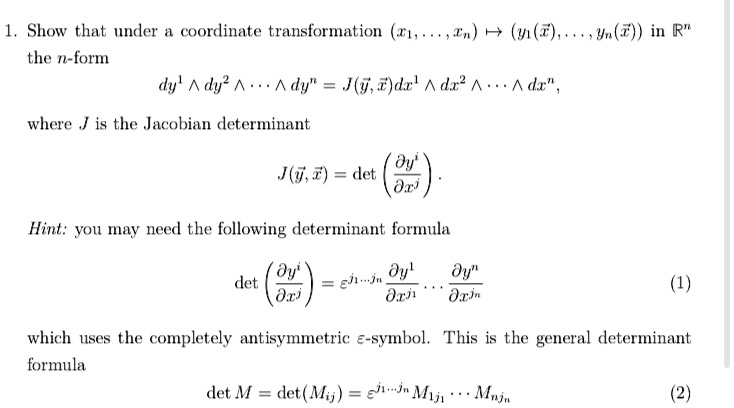
1. Show that under a coordinate transformation $(x_1, \dots, x_n) \to (y_1(\vec{x}), \dots, y_n(\vec{x}))$ in $\mathbb{R}^n$ the $n$-form $dy^1 \wedge dy^2 \wedge \dots \wedge dy^n = J(\vec{y}, \vec{x})dx^1 \wedge dx^2 \wedge \dots \wedge dx^n$, where $J$ is the Jacobian determinant $J(\vec{y}, \vec{x}) = \det \left(\frac{\partial y^i}{\partial x^j}\right)$. Hint: you may need the following determinant formula $\det \left(\frac{\partial y^i}{\partial x^j}\right) = \epsilon_{j_1 \dots j_n} \frac{\partial y^1}{\partial x^{j_1}} \dots \frac{\partial y^n}{\partial x^{j_n}}$ (1) which uses the completely antisymmetric $\epsilon$-symbol. This is the general determinant formula $\det M = \det(M_{ij}) = \epsilon_{j_1 \dots j_n} M_{1j_1} \dots M_{nj_n}$ (2)
View Answer
divider