Q5.
The age of the residents in a certain town is Normally distributed with an unknown mean ( mu ) and unknown standard deviation ( sigma ). The mayor knows that the average age 10 years ago was 35, but she thinks that the average age is now lower. To test this claim, she acquires a random sample of 40 residents which has a sample mean age of 36 years and a sample standard deviation of 6 years.
If the mayor uses R, which of the following is the ( P )-value she will use to test her claim?
A. 0.146
B. 0.149
C. 0.854
D. 0.851
Q6.
We wish to see if the dial indicating the oven temperature for a certain model of oven is properly calibrated. Four ovens of this model are selected at random. The dial on each oven is set to ( 300^{circ} mathrm{F} ) and, after one hour, the actual temperature of each is measured. The temperatures measured are ( 305^{circ} mathrm{F}, 310^{circ} mathrm{F}, 300^{circ} mathrm{F} ), and ( 305^{circ} mathrm{F} ). Assuming that the actual temperatures for this model, when the dial is set for ( 300^{circ} mathrm{F} ), are Normally distributed with mean ( mu ), we test whether the dial is properly calibrated by testing the hypotheses ( H_0: mu=300 ) versus ( H_a: mu
eq 300 ).
Based on the data, the ( P )-value for this test is:
A. between 0.05 and 0.10 .
B. between 0.025 and 0.05 .
C. between 0.01 and 0.025 .
Q7.
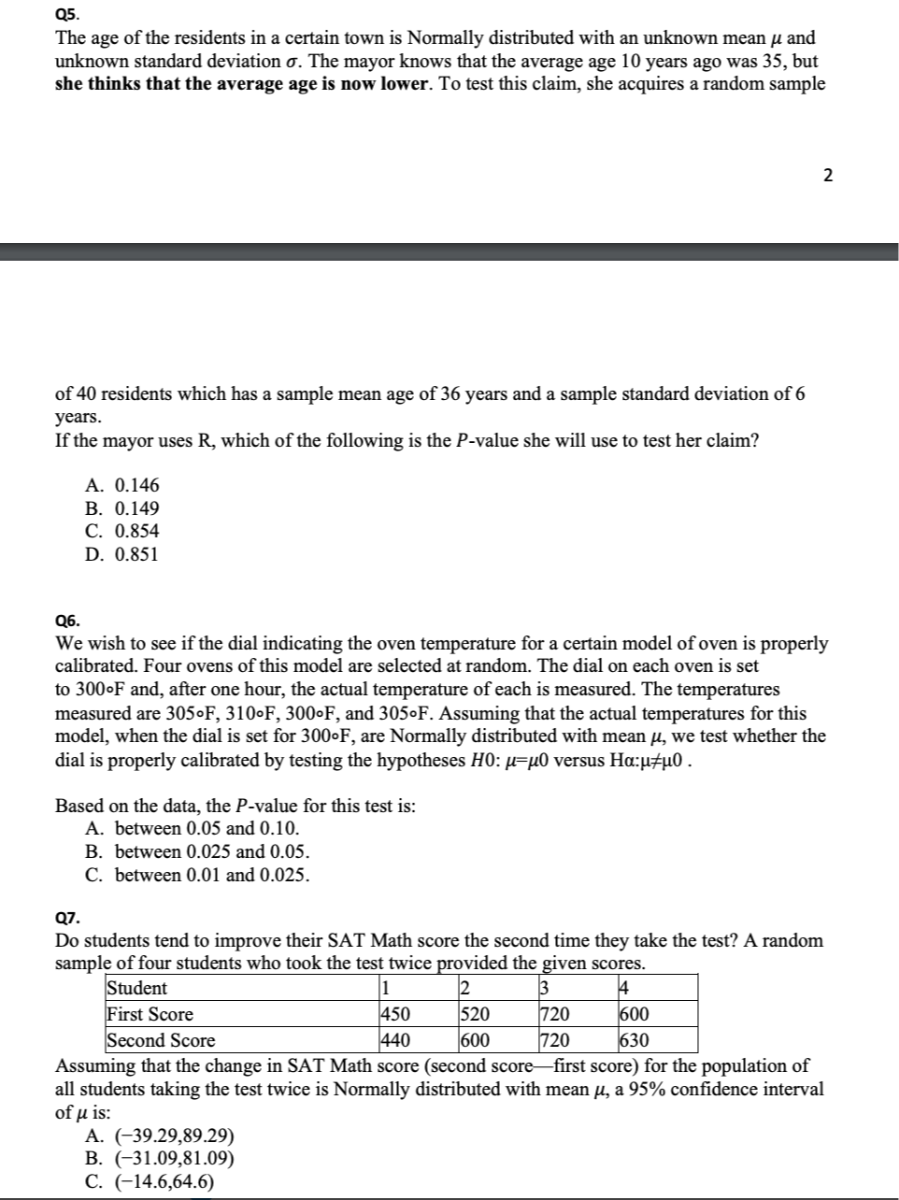
Do students tend to improve their SAT Math score the second time they take the test? A random sample of four students who took the test twice provided the given scores.
�egin{tabular}{|l|c|c|c|c|}
hline Student & 1 & 2 & 3 & 4 \
hline First Score & 450 & 520 & 720 & 600 \
hline Second Score & 440 & 600 & 720 & 630 \
hline
end{tabular}
Assuming that the change in SAT Math score (second score- first score) for the population of all students taking the test twice is Normally distributed with mean ( mu ), a ( 95 % ) confidence interval of ( mu ) is:
A. ( (-39.29, 89.29) )
B. ( (-31.09, 81.09) )
C. ( (-14.6, 64.6) )