SECTION D
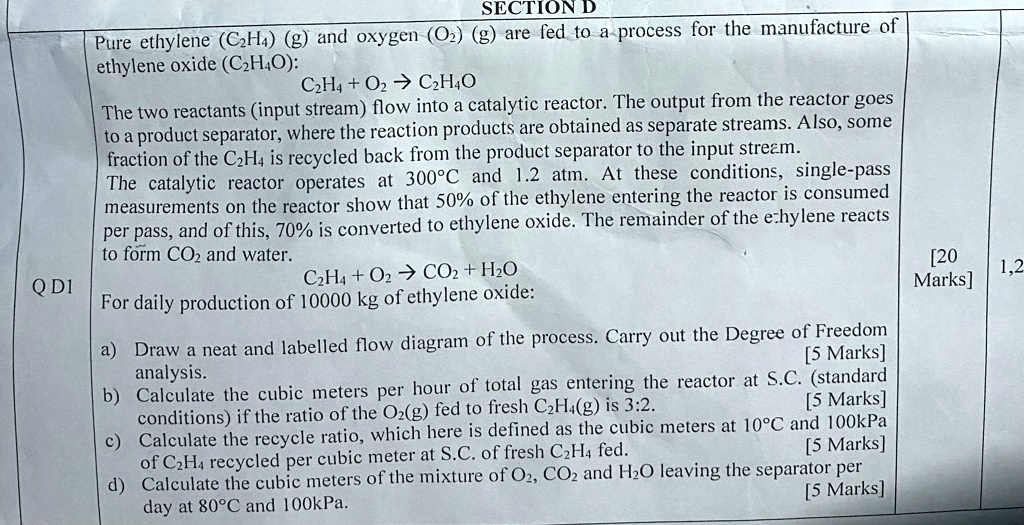
Pure ethylene ($$C_2H_4$$) (g) and oxygen ($$O_2$$) (g) are fed to a process for the manufacture of ethylene oxide ($$C_2H_4O$$):
$$C_2H_4 + O_2 \rightarrow C_2H_4O$$
The two reactants (input stream) flow into a catalytic reactor. The output from the reactor goes to a product separator, where the reaction products are obtained as separate streams. Also, some fraction of the $$C_2H_4$$ is recycled back from the product separator to the input stream.
The catalytic reactor operates at $$300^\circ C$$ and 1.2 atm. At these conditions, single-pass measurements on the reactor show that 50% of the ethylene entering the reactor is consumed per pass, and of this, 70% is converted to ethylene oxide. The remainder of the ethylene reacts to form $$CO_2$$ and water.
$$C_2H_4 + O_2 \rightarrow CO_2 + H_2O$$
QD1
For daily production of 10000 kg of ethylene oxide:
a) Draw a neat and labelled flow diagram of the process. Carry out the Degree of Freedom analysis. [5 Marks]
b) Calculate the cubic meters per hour of total gas entering the reactor at S.C. (standard conditions) if the ratio of the $$O_2(g)$$ fed to fresh $$C_2H_4(g)$$ is 3:2. [5 Marks]
c) Calculate the recycle ratio, which here is defined as the cubic meters at $$10^\circ C$$ and 100kPa of $$C_2H_4$$ recycled per cubic meter at S.C. of fresh $$C_2H_4$$ fed. [5 Marks]
d) Calculate the cubic meters of the mixture of $$O_2$$, $$CO_2$$ and $$H_2O$$ leaving the separator per day at $$80^\circ C$$ and 100kPa. [5 Marks]