Questions asked
Please simulate the reactors given in the figure below. The reversible reaction, which takes place at 70°C and 1 atm, is given as: Ethanol + Acetic Acid $\rightleftharpoons$ Ethyl Acetate + Water The reaction is first order with respect to each of the reactants (overall second order). The reaction rate is expressed by Arrhenius Equation ($k = k_0 e^{-E/RT}$). For the forward reaction, the preexponential factor is $1.9 \times 10^8$ m$^3$/kmol-s and the activation energy is $5.95 \times 10^7$ J/kmol. For the backward reaction, the preexponential factor is $5.0 \times 10^7$ m$^3$/kmol-s and the activation energy is $5.95 \times 10^7$ J/kmol. The reaction takes place in the liquid phase, and the components are in mole basis. Please consider mixed phase as the valid phase for each reactor. Simulate your process by using NRTL as the thermodynamic K value model and Latent Heat as the enthalpy model. a. What is the flow rate of ethyl acetate exiting each reactor in kmol/h? b. What is the conversion of ethanol for each reactor? c. In the PFR reactor, for each component, draw the composition profile (chose "moles" as the composition option) as a function of reactor volume. Feed: Temperature: 70°C, Pressure: 1 atm Water: 8.892 kmol/h Ethanol: 186.59 kmol/h Acetic Acid: 192.6 kmol/h Stoichiometric Reactor Ethanol: 70% conversion Gibbs Reactor PFR; L = 2 m, D = 0.3 m CSTR; V = 0.14 m$^3$ Equilibrium Reactor Ethanol: 70% conversion For PFR and CSTR, in "More Specifications" section, select the following: - Activation Energy: J - Molar flow: K-moles - Volume: Cubic meters - Time: Seconds
Question 5 (3 points) ? Saved The General Motors Asset Management Company, which manages the pension plan assets for General Motors Corp., is evaluating its liabilities. It pays out an average basic benefit of $1,590 per month to its auto workers with 30 years of service, of whom there are 670,000. It would like to capitalize this cost for the purposes of its analysis. Capitalize the cost of the plan benefit on an annualized basis if the discount rate is 7.5%. State your answer to the nearest dollar. Your Answer:
How do you calculate the mass percent of oxygen in the compund potassium chlorate (KClO3) via the thermal decomposition of a sample of potassium chlorate
\( 43=3-\frac{5}{9} e l \)
Mechanism Analysis of Swing Arm Polishing Machine Traditional polishing machine is used for lapping and polishing of spheres, plano surfaces and cylinders as single surfaces or multiple blocks The mechanism used in machine to hold the tool is also used to create a force on workpiece. 1) Determine the degree of freedom by using equation (DOF). • # of R Joints, # of P joints, # of Cp joints, # of Cs joints, # of G joints, # of S joints, # of C joints 2) Determine the number of independent loops 3) Perform the kinematic analysis of the mechanism. 4) Perform the dynamic analysis of the mechanism 5) Determine the down force on the tip of mechanism.
Given that 4 sin 0 = 7 7 'find the value(s) of tan 20.
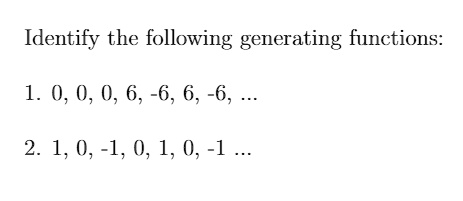
Identify the following generating functions: 1. 0, 0, 0, 6, -6, 6, -6, ... 2. 1, 0, -1, 0, 1, 0, -1 ...
19.5 The noninverting buffer op-amp configuration is shown in Fig. P10.3. Assuming that the op-amp has infinite input resistance and zero output resistance, what is ?? If A=1000, what is the closed-loop voltage gain? What is the amount of feedback (in dB)? For Vs=1V, find Vo and Vi. If A decreases by 10%, what is the corresponding percentage decrease in Af? (10 points)
c. The normal absorptance 10.12 A bilayer consists of a 15.0 nm silver layer ($n = 3.30$, $\kappa = 0.59$) and a 6.0 nm thin film of SiO ($n = 0.12$, $\kappa = 3.20$) is deposited on the silver film. The bilayer is deposited on a glass substrate ($n = 1.50$). Treating the bilayer as an ultrathin stack and for incident light of wavelength $\lambda = 540.0$ nm, determine a. The normal reflectance of the bilayer b. The normal transmittance of the bilayer 10.13 With no approximations, redo the previous problem, and assuming that the given optical constants of the constituent layers are fixed for the wavelength range 350.0-960.0 nm, use the CMT to a. Calculate the normal reflectance and transmittance for light of wavelength $\lambda = 540.0$ nm. b. Determine and plot the normal reflectance for this bilayer in the wavelength range 350.0-960.0 nm. 10.14 In the previous problem, assuming that the optical constants given at wavelength $\lambda = 540.0$ are fixed for the wavelengths range
5?j20? 45? 100?0°V j5?j125 Vab Figure 4: For Question 17 For the linear transformer circuit shown in figure 4, the open circuit voltage at terminal a,b is $V_{ab,open} = 282.8?45.0°$ V. The short circuit current when terminals a, b are shorted is $I_{ab,sc} = 2.353?0.00°$ A. A variable resistor R is attached to terminals a,b and tuned until the most real power possible is transferred to the resistor. 17. What is the resistance R? (a) 8.3 m? (b) 314 ? (c) 120 ? (d) 10 ? (e) None of the above 18. What is the real power absorbed by R? (a) 56.3 W (b) 143 W (c) 35.7 W (d) 97.5 W (e) None of the above