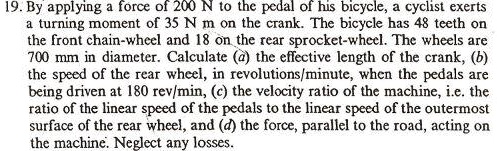
19. By applying a force of 200 N to the pedal of his bicycle, a cyclist exerts
a turning moment of 35 N m on the crank. The bicycle has 48 teeth on
the front chain-wheel and 18 on the rear sprocket-wheel. The wheels are
700 mm in diameter. Calculate (a) the effective length of the crank, (b)
the speed of the rear wheel, in revolutions/minute, when the pedals are
being driven at 180 rev/min, (c) the velocity ratio of the machine, i.e. the
ratio of the linear speed of the pedals to the linear speed of the outermost
surface of the rear wheel, and (d) the force, parallel to the road, acting on
the machine. Neglect any losses.