Ace - AI Tutor
Ask Our Educators
Textbooks
My Library
Flashcards
Scribe - AI Notes
Notes & Exams
Download App
seth johnson

seth j.

Divider

Questions asked

BEST MATCH

78-year-old woman with Alzheimer's disease in the end stage of the disease is no longer able to communicate effectively and is experiencing severe difficulty swallowing. The family is torn about whether to pursue hospice care or continue with active treatment, including intravenous fluids. Which of the following is the most important consideration when deciding on the appropriateness of hospice care for this patient? Group of answer choices The patient's cognitive status and inability to recognize family members. The patient's life expectancy and the likelihood of recovery from the current medical condition. The patient's documented preference for a natural death and for comfort-focused care. The family's financial ability to pay for hospice care services.

View Answer
divider
BEST MATCH

Describe the efficiency of a Gas turbine combined cycle power plant system.

View Answer
divider
BEST MATCH

This phylogenetic tree has five organisms (A, B, C, D, and E). Which organism is most closely related to D? Question 3 options: A B C D E

View Answer
divider
BEST MATCH

Question 13 0. 5 pts Genetic engineering uses gene transfer techniques to cut out bad genes and replace with healthy genes True False

View Answer
divider
BEST MATCH

9. Which of the following conversions involves oxidation? A) BF$_3$ ? BF$_4$$^{-1}$ D) H$_2$O$_2$ ? H$_2$O B) O$_3$ ? O$_2$ E) Ti$^{3+}$ ? TiO$^{2+}$ C) SO$_2$ ? CaSO$_3$

View Answer
divider
BEST MATCH

Which of the following is TRUE? 1. An organ system is least vulnerable to the effects of a teratogen when it is developing rapidly. 2. The effects of a teratogen do not appear to be related to the "dose" received. 3. The genetic makeup of a fetus can influence the impact of a teratogen. 4. The quality of a postnatal environment has little impact on the effect of a teratogen.

View Answer
divider
BEST MATCH

R10 10 R20 R25 Rubrics (Marking Criteria): Accuracy: 6 Center Circle Notch: 4 20 45' TAPER 10 85

View Answer
divider
BEST MATCH

Problem 4: Locate the x and y component of the centroid for the composite area. (25 points) 200mm 20mm 150 mm 20mm 20mm 100 mm

View Answer
divider
BEST MATCH

A centrifugal pump performance data are shown in the following table for water. Pump speed = 2500 RPM Discharge Suction Volume of water Time (sec) Input-Power (W) pressure(Kpa) pressure (Kpa) collected (Liter) 200 -70 20 60 200 For this data set, calculate the following: i. Pump discharge capacity Q (L/s and GPM) [3 points] ii. Pump head H (m and ft) [3 points] iii. Fluid power Pf (Watt) [2 points] iv. Brake power Pb (Watt) [1 point] v. Pump overall efficiency $\eta$ (%) [1 point] vi. Flow rate coefficient $C_q$ (or dimensionless specific capacity) [2 points] vii. Head coefficient $C_h$ (or dimensionless specific head) [2 points] viii. Power coefficient $C_p$ (or dimensionless specific power) [3 points] ix. If this is the maximum pump efficiency, the specific speed of the pump $N_{s,us}$ [3 points] 1 m³ = 1000 L, 1 Gallon = 3.78541 Liters, 1 m = 3.281 ft, Specific weight of water = 9.8 KN/m³ Suction pipe diameter and discharge pipe diameter are equal, the height difference between suction pressure gauge and discharge pressure gauge = 0 Efficiency of the motor = 90%, Pump impeller diameter = 100 mm

View Answer
divider
BEST MATCH

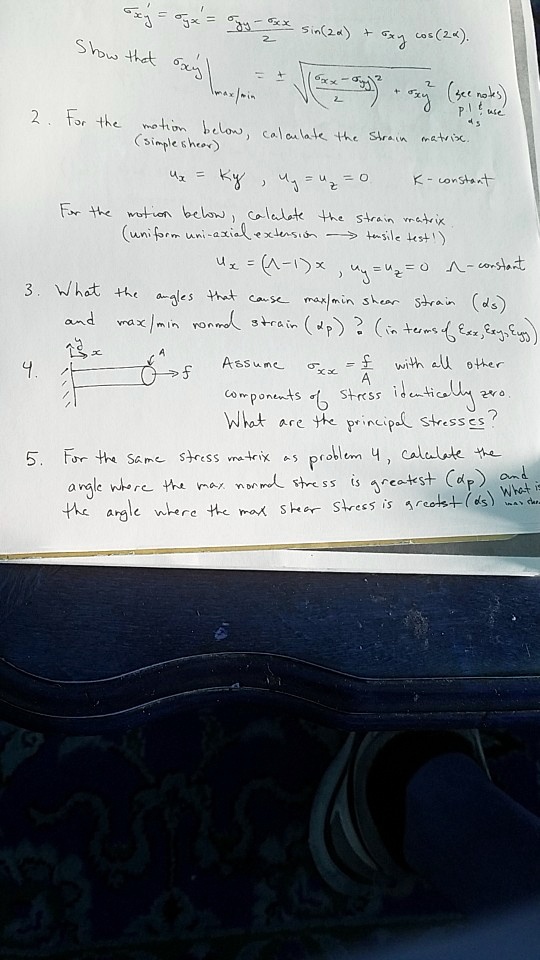
\frac{\partial \sigma_{xy}}{\partial \theta} = \frac{\sigma_{yy} - \sigma_{xx}}{2} \sin(2\theta) + \sigma_{xy} \cos(2\theta). Show \text{ that } \sigma_{xy}|_{max/min} = \pm \sqrt{(\frac{\sigma_{xx} - \sigma_{yy}}{2})^2 + \sigma_{xy}^2} \text{ (see notes) p.45 use} 2. For the motion below, calculate the Strain matrix. (simple shear) u_x = Ky, \quad u_y = u_z = 0. \quad K-\text{constant} For the motion below, calculate the Strain matrix (uniform uni-axial extension \to tensile test!) u_x = (\lambda - 1)x, \quad u_y = u_z = 0 \quad \lambda-\text{constant} 3. What the angles that cause max/min shear strain ($d_s$) and max/min normal strain ($d_p$) ? (in terms of $\epsilon_{xx}, \epsilon_{xy}, \epsilon_{yy}$) 4. \begin{tikzpicture}[scale=0.8] \draw[thick] (0,0) -- (4,0); \draw[thick] (0,0) -- (0,-0.5); \draw[thick] (4,0) -- (4,-0.5); \draw[thick,->] (4,0) -- (5,0) node[midway,above]{$F$}; \draw[thick] (2,0) circle (0.2); \draw[thick,->] (2,0.2) -- (2,0.5) node[midway,right]{$A$}; \end{tikzpicture} Assume $\sigma_{xx} = \frac{F}{A}$ with all other components of $\sigma$ stress identically zero. What are the principal stresses? 5. For the same stress matrix as problem 4, calculate the angle where the max normal stress is greatest ($\alpha_p$) and the angle where the max shear stress is greatest ($\alpha_s$). What is
View Answer
divider