Ace - AI Tutor
Ask Our Educators
Textbooks
My Library
Flashcards
Scribe - AI Notes
Notes & Exams
Download App
Shabir Ahmed

Shabir A.

Divider

Questions asked

INSTANT ANSWER

\( \leftarrow \quad \) View embed \( \quad \) unknown.png A two - stage ammonia compression refrigerating system with flash intercooling and flash gas removal has a mass flow rate of \( 0.20 \mathrm{~kg} / \mathrm{sec} \) to the evaporator and has the following operating parameters: evaporating temperature of \( -30^{\circ} \mathrm{C} \) and a condensing pressure of \( 1000 \mathrm{kPa} \). Saturated refrigerant vapor exits the evaporator and enters the suction of the compressor at with a 10 -degree superheat. The vapor leaving the flash tank is superheated by \( 10^{\circ} \mathrm{C} \) in the suction line to the second - stage a. Determine the refrigeration load, \( \mathrm{kW}[10 \) points] b. Calculate the brake power input to the low - stage compressor, kW [10 points]. c. Calculate the brake power input to the high- stage compressor, kW [10 points]. d. Calculate the refrigerating efficiency of the system [10 points]. e. Compare the performance of the system to a single - stage system [10 points]. 111 \( \dot{\pi} \)

View Answer
divider
INSTANT ANSWER

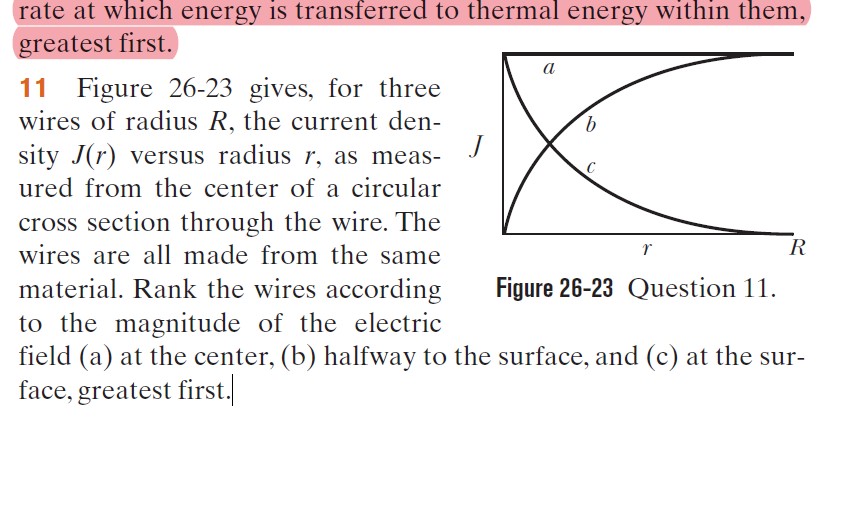
rate at which energy is transferred to thermal energy within them, greatest first. 11 Figure 26-23 gives, for three wires of radius \( R \), the current density \( J(r) \) versus radius \( r \), as measured from the center of a circular cross section through the wire. The wires are all made from the same material. Rank the wires according to the magnitude of the electric field (a) at the center, (b) halfway to the surface, and (c) at the surface, greatest first.
View Answer
divider
ANSWERED

Penny Riley verified

Numerade educator

A nerve signal is transmitted along the long, thin axon of a neuron in a small fish. The transmission occurs as sodium ions (Na) transfer like tipping dominos across the axon membrane from outside to inside. Each short section of axon gets an excess of about 6 x 10 sodium ions/mm. Determine the E field 4.0 cm from the axon produced by the excess sodium ions on the inside of the axon and an equal number of negative ions on the outside of a 1-mm length of axon. The ions are separated by the 8 x 10 9 -m-thick axon membrane. Will a shark that is able to detect fields as small as 10 N/C be able to detect that axon field? Explain.

View Answer
divider
INSTANT ANSWER

58. * EST Figure P18.58? shows a region of space with an electric field. Vertical lines indicate equipotential surfaces. A particle with charge \( -3.0 \mathrm{nC} \) is initially at the location of the \( -20-\mathrm{V} \) equipotential line. At time \( t=0 \) the particle is released from rest. (a) Estimate the force exerted by the electric field on the particle when it passes the \( 0-\mathrm{V} \) equipotential line and when it passes the \( 80-\mathrm{V} \) equipotential line. (b) Draw a qualitative velocity-versus-time graph for the motion of the particle until it reaches the potential \( 120 \mathrm{~V} . \) (c) Determine the kinetic energy of the particle when it passes the \( 60-\mathrm{V} \) equipotential line. (d) Do the data in the problem allow you to estimate the time needed for the particle to move from the \( -20-\mathrm{V} \) line to the 120 V line? If you think the answer is no, list the additional data that are needed. Ignore the force exerted by Earth on the particle. Figure P18.58

View Answer
divider
ANSWERED

Hafiz Shahzaib verified

Numerade educator

57. * Four charged particles A, B, C, and D are placed in an electric field as shown in Figure P18.57. Vertical lines indicate equipotential surfaces of the V field. All particles are initially at rest. When they are released, they all start moving to the left. (a) Determine the signs of the charges on the particles. Rank (b) the kinetic energies of the particles and (c) the speeds of the particles as they cross the -600-V equipotential line. Relative masses and charges of the particles are indicated in the figure. Assume the particles are far from each other so they do not interact, and ignore forces exerted by Earth on the particles. Figure P18.57

View Answer
divider
ANSWERED

Eduard Sanchez verified

Numerade educator

Assume that a red blood cell is spherical with a radius of 4 x 10⁷ mn and with wall thickness of 9x 10 m. The dielectric constant of the membrane is about 5. Assuming the cell is a parallel plate capacitor, estimate the capacitance of the cell and determine the positive charge on the outside and the equal magnitude negative charge inside when the potential difference across the membrane is 0.080 V.

View Answer
divider
INSTANT ANSWER

Two identical metal plates that are touching each other are placed in a uniform electric field as shown in Figure Q18.340. The electric field is created by a parallel plate capacitor with capacitance 150 PF and potential difference 3600 V between the plates. The surface area of the capacitor plates is 10 times larger than the surface area of the part metal plates. You move the metal plates part (while still in the electric field) and then move them out of the field. Estimate the final charge on each metal plate.

View Answer
divider
ANSWERED

Bhushan Kumar verified

Numerade educator

40. ** BIO Electric field of a fish An African fish called the aba has a charge q = + 1.0 × 10^{-7} C at its head and an equal magnitude negative charge -q at its tail (see Figure P18.40). Determine the magnitude and direction of the electric field at position A and the force exerted on a hydroxide ion (charge -e) at that point. The fish and ion are in water. Indicate any assumptions that you made. Figure P18.40

View Answer
divider
ANSWERED

Sufiyan Alam verified

Numerade educator

39. * An electric dipole such as a water molecule is in a uniform ( vec{E} ) field. (a) Will the force exerted by the field cause the dipole to have a linear acceleration along a line in the direction of ( vec{E} ) ? Explain. (b) Will the field exert a torque on the dipole? Explain.

View Answer
divider
ANSWERED

Ayushi Sambyal verified

Numerade educator

29. * BIO EST Energy used to charge nerve cells A nerve cell is shaped like a cylinder. The membrane wall of the cylinder has a +0.07-V potential difference from the inside to the outside of the wall. To help maintain this potential difference, sodium ions are pumped from inside the cell to the outside. For a typical cell, 10^9 ions are pumped each second. (a) Determine the change in chemical energy each second required to produce this increase in electric potential energy. (b) If there are roughly 7 x 10^11 of these cells in the body, how much chemical energy is used in pumping sodium ions each second? (c) Estimate the fraction of a person's metabolic rate used to pump these ions.

View Answer
divider