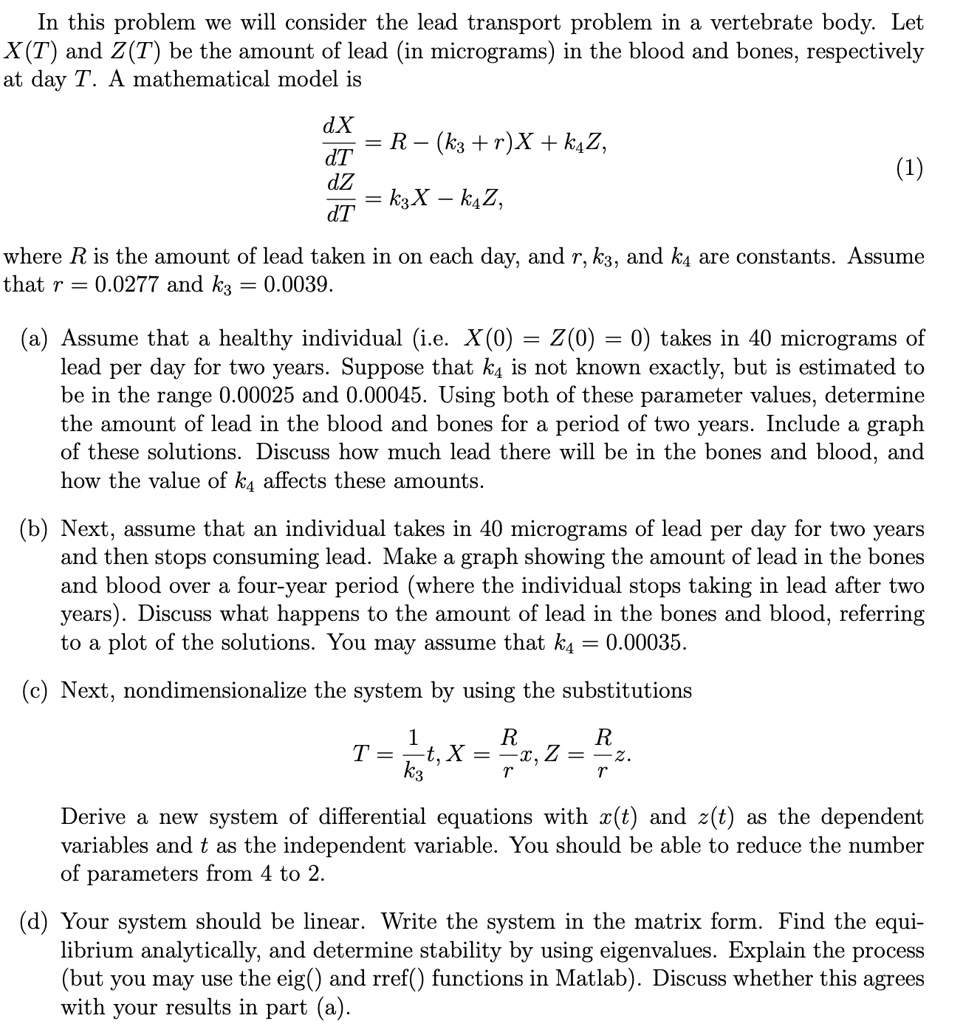
In this problem we will consider the lead transport problem in a vertebrate body. Let
x(T) and Z(T) be the amount of lead (in micrograms) in the blood and bones, respectively
at day T. A mathematical model is
(dx)/(dT)=R-(k_(3)+r)x+k_(4)Z
(dZ)/(dT)=k_(3)x-k_(4)Z
where R is the amount of lead taken in on each day, and r,k_(3), and k_(4) are constants. Assume
that r=0.0277 and k_(3)=0.0039.
(a) Assume that a healthy individual (i.e. x(0)=Z(0)=0 ) takes in 40 micrograms of
lead per day for two years. Suppose that k_(4) is not known exactly, but is estimated to
be in the range 0.00025 and 0.00045 . Using both of these parameter values, determine
the amount of lead in the blood and bones for a period of two years. Include a graph
of these solutions. Discuss how much lead there will be in the bones and blood, and
how the value of k_(4) affects these amounts.
(b) Next, assume that an individual takes in 40 micrograms of lead per day for two years
and then stops consuming lead. Make a graph showing the amount of lead in the bones
and blood over a four-year period (where the individual stops taking in lead after two
years). Discuss what happens to the amount of lead in the bones and blood, referring
to a plot of the solutions. You may assume that k_(4)=0.00035.
(c) Next, nondimensionalize the system by using the substitutions
T=(1)/(k_(3))t,x=(R)/(r)x,Z=(R)/(r)z.
Derive a new system of differential equations with x(t) and z(t) as the dependent
variables and t as the independent variable. You should be able to reduce the number
of parameters from 4 to 2 .
(d) Your system should be linear. Write the system in the matrix form. Find the equi-
librium analytically, and determine stability by using eigenvalues. Explain the process
(but you may use the eig() and rref() functions in Matlab). Discuss whether this agrees
with your results in part (a).
In this problem we will consider the lead transport problem in a vertebrate body. Let X(T) and Z(T) be the amount of lead (in micrograms) in the blood and bones, respectively at day T. A mathematical model is
dX =R-(k3+r)X+k4Z dT dZ =k3X-k4Z dT
(1)
where R is the amount of lead taken in on each day, and r, k3, and k4 are constants. Assume that r=0.0277 and k3 =0.0039
a) Assume that a healthy individual (i.e. X(0) = Z(0) = 0) takes in 40 micrograms of lead per day for two years. Suppose that k4 is not known exactly, but is estimated to be in the range 0.00025 and 0.00045. Using both of these parameter values, determine the amount of lead in the blood and bones for a period of two years. Include a graph of these solutions. Discuss how much lead there will be in the bones and blood, and how the value of k4 affects these amounts.
(b) Next, assume that an individual takes in 40 micrograms of lead per day for two years and then stops consuming lead. Make a graph showing the amount of lead in the bones and blood over a four-year period (where the individual stops taking in lead after two years). Discuss what happens to the amount of lead in the bones and blood, referring to a plot of the solutions. You may assume that k4 = 0.00035.
(c) Next, nondimensionalize the system by using the substitutions
R
R Z
.X
Derive a new system of differential equations with x(t) and z(t) as the dependent variables and t as the independent variable. You should be able to reduce the number of parameters from 4 to 2.
(d) Your system should be linear. Write the system in the matrix form. Find the equi- librium analytically, and determine stability by using eigenvalues. Explain the process (but you may use the eigO and rrefO functions in Matlab). Discuss whether this agrees with your results in part (a).