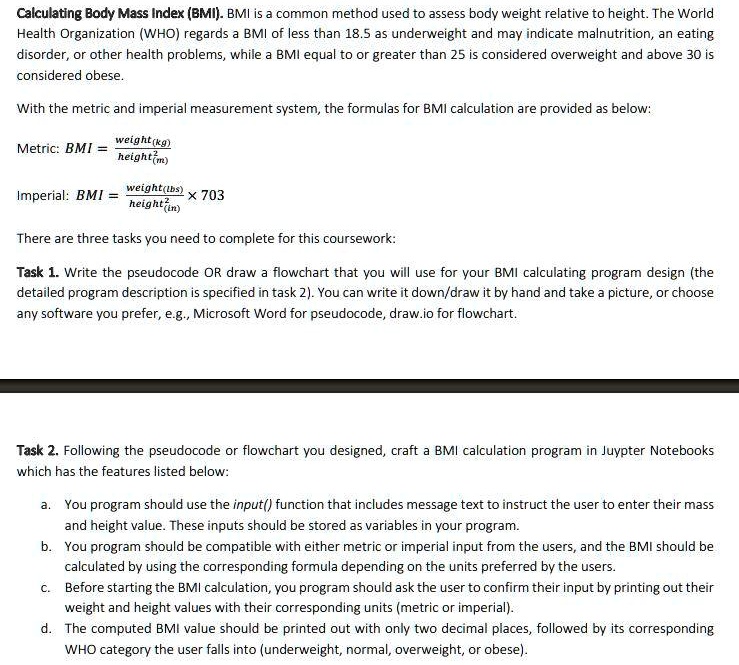
Calculating Body Mass Index (BMI). BMI is a common method used to assess body weight relative to height. The World
Health Organization (WHO) regards a BMI of less than 18.5 as underweight and may indicate malnutrition, an eating
disorder, or other health problems, while a BMI equal to or greater than 25 is considered overweight and above 30 is
considered obese.
With the metric and imperial measurement system, the formulas for BMI calculation are provided as below:
Metric: BMI = $\frac{weight(kg)}{height(m)^2}$
Imperial: BMI = $\frac{weight(lbs)}{height(in)^2}$ x 703
There are three tasks you need to complete for this coursework:
Task 1. Write the pseudocode OR draw a flowchart that you will use for your BMI calculating program design (the
detailed program description is specified in task 2). You can write it down/draw it by hand and take a picture, or choose
any software you prefer, e.g., Microsoft Word for pseudocode, draw.io for flowchart.
Task 2. Following the pseudocode or flowchart you designed, craft a BMI calculation program in Juypter Notebooks
which has the features listed below:
a. You program should use the input() function that includes message text to instruct the user to enter their mass
and height value. These inputs should be stored as variables in your program.
b. You program should be compatible with either metric or imperial input from the users, and the BMI should be
calculated by using the corresponding formula depending on the units preferred by the users.
c. Before starting the BMI calculation, you program should ask the user to confirm their input by printing out their
weight and height values with their corresponding units (metric or imperial).
d. The computed BMI value should be printed out with only two decimal places, followed by its corresponding
WHO category the user falls into (underweight, normal, overweight, or obese).