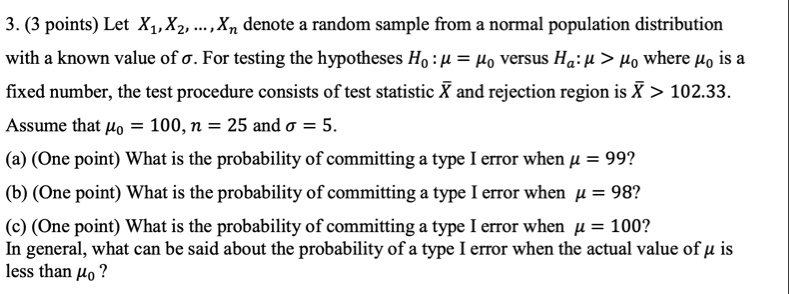
3. (3 points) Let $X_1, X_2, ..., X_n$ denote a random sample from a normal population distribution
with a known value of $\sigma$. For testing the hypotheses $H_0: \mu = \mu_0$ versus $H_a: \mu > \mu_0$ where $\mu_0$ is a
fixed number, the test procedure consists of test statistic $\bar{X}$ and rejection region is $\bar{X} > 102.33$.
Assume that $\mu_0 = 100$, $n = 25$ and $\sigma = 5$.
(a) (One point) What is the probability of committing a type I error when $\mu = 99$?
(b) (One point) What is the probability of committing a type I error when $\mu = 98$?
(c) (One point) What is the probability of committing a type I error when $\mu = 100$?
In general, what can be said about the probability of a type I error when the actual value of $\mu$ is
less than $\mu_0$?