Paragraph
Styles
Tating
Force
Sensitivity
Editor
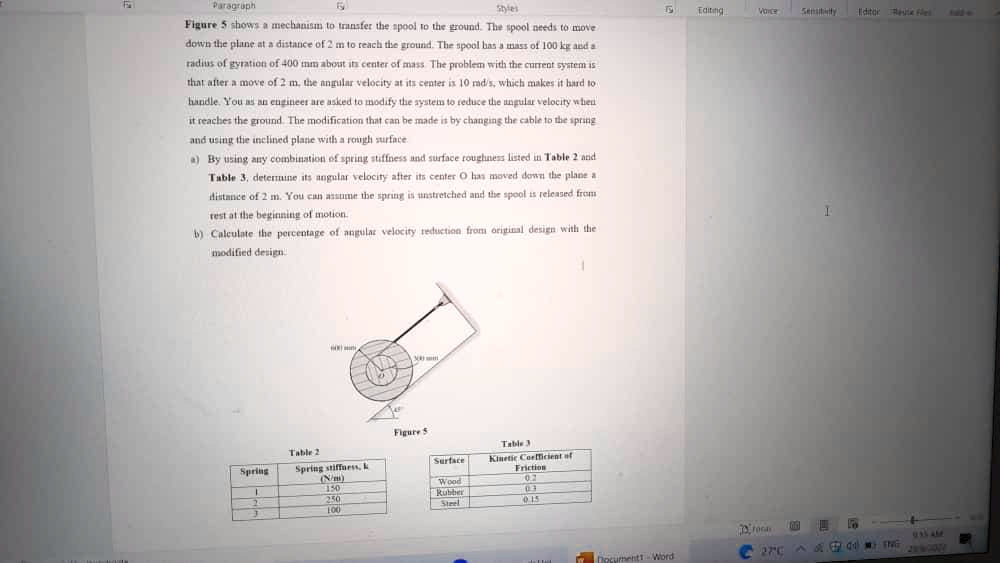
Figure 5 shows a mechanism to transfer the spool to the ground. The spool needs to move down the plane at a distance of 2 m to reach the ground. The spool has a mass of 100 kg and a radius of gyration of 400 mm about its center of mass. The problem with the current system is that after a move of 2 m, the angular velocity at its center is 10 rad/s which makes it hard to handle. You, as an engineer, are asked to modify the system to reduce the angular velocity when it reaches the ground. The modification that can be made is by changing the cable to a spring and using an inclined plane with a rough surface. By using any combination of spring stiffness and surface roughness listed in Table 2 and Table 3, determine its angular velocity after its center O has moved down the plane a distance of 2 m. You can assume the spring is unstretched and the spool is released from rest at the beginning of motion. Calculate the percentage of angular velocity reduction from the original design with the modified design.
Figure's
Table 2: Spring stiffness, L (N/m) - 150, 250, 100
Table 3: Surface - Wood, Rubber
1. Corrected_text:
Paragraph
Styles
Tating
Force
Sensitivity
Editor
Figure 5 shows a mechanism to transfer the spool to the ground. The spool needs to move down the plane at a distance of 2 m to reach the ground. The spool has a mass of 100 kg and a radius of gyration of 400 mm about its center of mass. The problem with the current system is that after a move of 2 m, the angular velocity at its center is 10 rad/s which makes it hard to handle. You, as an engineer, are asked to modify the system to reduce the angular velocity when it reaches the ground. The modification that can be made is by changing the cable to a spring and using an inclined plane with a rough surface. By using any combination of spring stiffness and surface roughness listed in Table 2 and Table 3, determine its angular velocity after its center O has moved down the plane a distance of 2 m. You can assume the spring is unstretched and the spool is released from rest at the beginning of motion. Calculate the percentage of angular velocity reduction from the original design with the modified design.
Figure's
Table 2: Spring stiffness, L (N/m) - 150, 250, 100
Table 3: Surface - Wood, Rubber