8.2 Repeat Example 8.3 for the initial conditions heta _(1)(0)= heta _(2)(0)=0 and heta _(1)^(˙)(0)= heta _(2)^(˙)(0)=0.5ra(d)/(s).
EXAMPLE 8.3
The two-inertia rotational system modeled in Example 4.2 is shown in Figure 8.4, with the viscous damping in the original version omitted. Find and sketch the zero-input response heta _(1)(t) for the parameter values J_(1)=J_(2)=1 kg*m^(2),K_(1)=1N*(m)/(r)ad, and K_(2)=2N*(m)/(r)ad, with the initial conditions heta _(1)(0)= heta _(2)(0)=0.5rad and heta _(1)^(˙)(0)= heta _(2)^(˙)(0)=0.
rivunc 0.4 nulaulial sysiem IU cxample o.s.
Solution
By substituting numerical values for J_(1),J_(2),K_(1), and K_(2) into (4.26) and setting B_(1)=B_(2)= au _(a)(t)=0, we obtain the system model
heta _(1)^(¨)+3 heta _(1)-2 heta _(2)=0
heta _(2)^(¨)+2 heta _(2)-2 heta _(1)=0
At this point, we could combine the pair of equations into a single homogeneous fourth-order differential equation for heta _(1) and then transform the result to obtain Theta _(1)(s). However, that approach would require knowledge of heta _(1)^(¨)(0) and heta _(1)^(¨)(0). When we are working with coupled equations, including state-variable equations, it is more convenient to transform the differential equations immediately and then to solve the transformed equations for the transform of the desired output.
When transformed with the specified initial conditions, (14) becomes
(s^(2)+3)Theta _(1)(s)-2Theta _(2)(s)=0.5s
-2Theta _(1)(s)+(s^(2)+2)Theta _(2)(s)=0.5s
Solying these two simultaneous algebraic equations for Theta _(1)(s) yields
Theta _(1)(s)=(0.5s^(3)+2s)/(s^(4)+5s^(2)+2)
Although the denominator of Theta _(1)(s) is a polynomial of degree four in s, it contains only even powers of s and can be factored into the product (s^(2)+0.4384)(s^(2)+4.562) by means of the quadratic formula. Thus we can decompose Theta _(1)(s) into the sum of two terms having quadratic denominators, The expansion of Theta _(1)(s) is
Theta _(1)(s)=(A_(1)s+B_(1))/(s^(2)+0.4384)+(A_(2)s+B_(2))/(s^(2)+4.562)
To evaluate the coefficients A_(1),A_(2),B_(1), and B_(2), we put the right-hand side of (16) over a common denominator and compare the numerator coefficients to those of (15). Doing this, we obtain the following four equations:
A_(1)+A_(2)=0.5
B_(1)+B_(2)=0
4.562A_(1)+0.4384A_(2)=2
4.562B_(1)+0.4384B_(2)=0
Solving these equations and substituting the results into (16), we find that
Theta _(1)(s)=(0.4319s)/(s^(2)+0.6622^(2))+(0.0681s)/(s^(2)+2.136^(2))
Referring to Appendix B, we see that the response is
heta _(1)(t)=0.4319cos0.6622t+0.0681cos2.136t for t>0
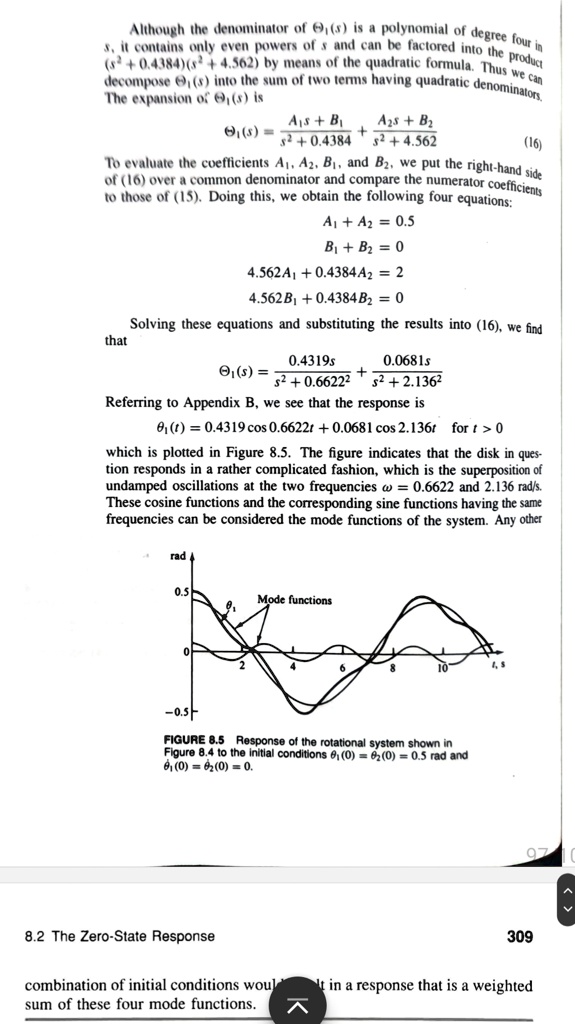
which is plotted in Figure 8.5. The figure indicates that the disk in question responds in a rather complicated fashion, which is the superposition of undamped oscillations at the two frequencies omega =0.6622 and 2.136ra(d)/(s). These cosine functions and the corresponding sine functions having the same frequencies can be considered the mode functions of the system. Any other
8.2 The Zero-State Response
309
combination of initial conditions would result in q response that is a weighted
sum of these four mode functions.
The expansion ofs is AS+BAS+B
(16)
A+A=0.5 B+B=O
4.562A+0.4384A=2
4.562B+0.4384B=0
that
0.4319s 0.0681s (s= s2 + 0.66222 2 + 2.1362 Referring to Appendix B, we see that the response is t=0.4319 cos0.6622t+0.0681 cos2.136tfor t>0
which is plotted in Figure 8.5. The figure indicates that the disk in ques- tion responds in a rather complicated fashion, which is the superposition of undamped oscillations at the two frequencies = 0.6622 and 2.136 rad/s. These cosine functions and the corresponding sine functions having the same frequencies can be considered the mode functions of the system. Any other
rad
Mode functions
FIGURE 8.5 Response of the rotational system shown in Figure 8.4 to the initial conditions 0=0=0.5 rad and 0=0=0.
8.2 The Zero-State Response
309
combination of initial conditions woul sum of these four mode functions.
t in a response that is a weighted