Ace - AI Tutor
Ask Our Educators
Textbooks
My Library
Flashcards
Scribe - AI Notes
Notes & Exams
Download App
shawn cruz

shawn c.

Divider

Questions asked

BEST MATCH

The instrument for measuring electric current is a(n) O ammeter O ohmmeter O shunt O voltmeter

View Answer
divider
BEST MATCH

What is special about the horizontal direction velocity of a projectile?

View Answer
divider
BEST MATCH

Evaluate the following indefinite integral.\\ $\int \frac{e^{5y}}{2 + e^{10y}} dy = $

View Answer
divider
BEST MATCH

15) In humans, three recessive genes (m, n, and o) are linked. A recessive is crossed with a wild-type plant. The F? is crossed to get an F? generation with the following results: m+ n o+: 445 m n+ o: 460 m+ n+ o: 215 m n o+: 200 m+ n+ o+: 75 m n o: 90 m+ n o: 35 m n+ o+: 25 What is the order of the three genes? (Circle one of the answer choices below). A) m-n-o B) m-o-n

View Answer
divider
BEST MATCH

Please help me choose correct answer for the following question A cornerstone of Christian philosophy is the text A) the city of God B) the realm of the Lord c) the gospel of Paul D) the word of Matthew

View Answer
divider
BEST MATCH

< HW 07 (from Ch. 8: Rotational Kinematics) > Question 8 of 12 ←HW 07 (from Ch. 8: Rotational Kinematics) (a) Number i Your answer is partially correct. Units rad/s (b) Number i Units Hint esc eTextbook and Media + A wind turbine is initially spinning at a constant angular speed. As the wind's strength gradually increases, the turbine experiences a constant angular acceleration of 0.146 rad/s². After making 2870 revolutions, its angular speed is 134 rad/s. (a) What is the initial angular velocity of the turbine? (b) How much time elapses while the turbine is speeding up? education.wiley.com sop F1 Save for Later Last saved 1 second ago. Saved work will be auto-submitted on the due date. Auto-submission can take up to 10 minutes. C 2 WP Question 8 of 12 - HW 07 (from Ch. 8: Rotational Kine... 0.1/1 80 F3 Attempts: unlimited 888 F4 + 96 5 E : A F5 ! 50 ! SUPPORT 6 ChatGPT ← → C = ChatGPT 3.5 tangential acceleration T is the radius, a is the angular acceleration. The acceleration due to gravity (g) approximately

View Answer
divider
BEST MATCH

A six-sided die (with sides numbered 1 through 6) is rolled and the result is recorded. Find the probability that the result was a) 5 b) a multiple of 5 d) a number less than 5

View Answer
divider
BEST MATCH

me wrk Set #8-Chapter 8 ental Problem 8.2 100 mm 100 mm 300 mm a 0.5 m <1 of 1 > P 2010 Section a-a e a Part A < 4 of 10 Determine the state of stress at point A on the cross section at section $a-a$ of the cantilever beam Take $P = 430$ kN. (Figure 1) Express your answer to three significant figures and include the appropriate units. Enter negative in the case of compression and positive in the case of tension. ?A ? $\sigma_A =$ Value Units Submit Request Answer Part B Find $\tau_A$ Express your answer to three significant figures and include the appropriate units. 9:53 P 11/2/20

View Answer
divider
BEST MATCH

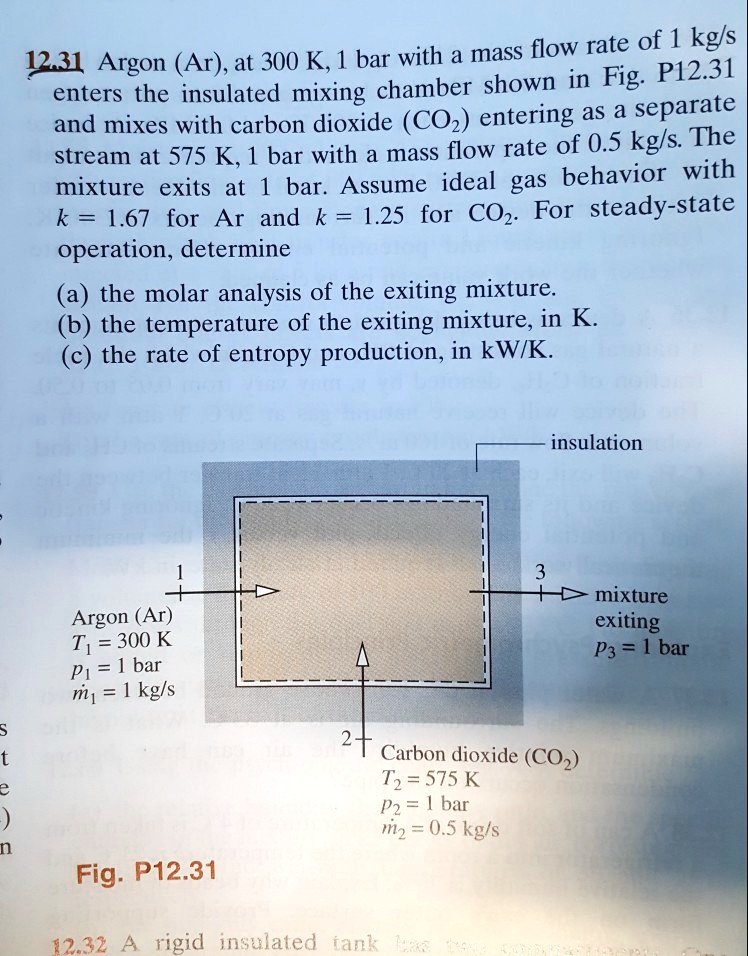
12.31 Argon (Ar), at 300 K, 1 bar with a mass flow rate of 1 kg/s enters the insulated mixing chamber shown in Fig. P12.31 and mixes with carbon dioxide ($CO_2$) entering as a separate stream at 575 K, 1 bar with a mass flow rate of 0.5 kg/s. The mixture exits at 1 bar. Assume ideal gas behavior with $k = 1.67$ for Ar and $k = 1.25$ for $CO_2$. For steady-state operation, determine (a) the molar analysis of the exiting mixture. (b) the temperature of the exiting mixture, in K. (c) the rate of entropy production, in kW/K.
View Answer
divider
BEST MATCH

Exercise 1: Generate the system with transfer function model of this system and generate it in MATLAB $X_{(s)} = \frac{4s^2 + 5}{s^2 + 6s + 9}$ Exercise 2: Determine the roots of the denominator polynomial of exercise 1 Exercise 3: Generate the state-space model of the system of exercise 1 using any model transformation technique. Exercise 4: Plot the pole-zero map of the system of exercise 1 Exercise 5: Generate the zero-pole-gain model of the system of exercise 1 using any model transformation technique. Exercise 6: Retrieve the numerator and denominator of the transfer function

View Answer
divider