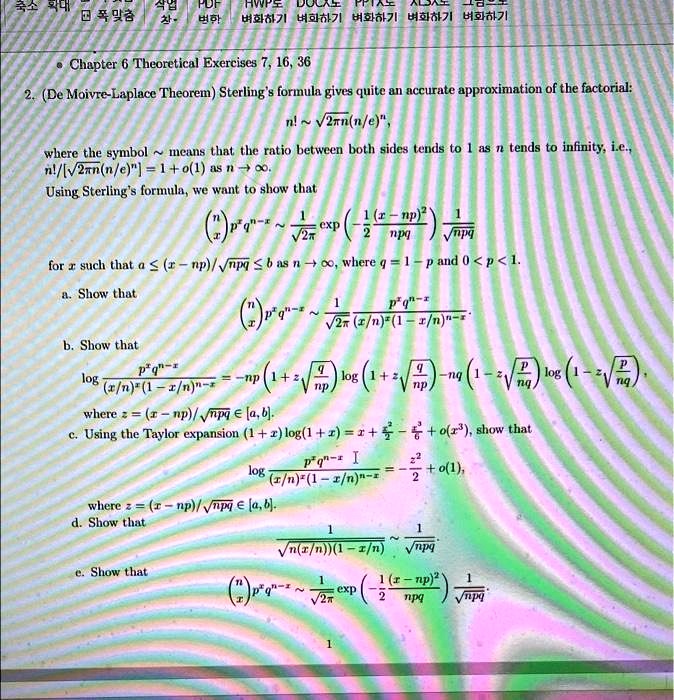
Texts: (De Moivre-Laplace Theorem) Sterling's formula gives quite an accurate approximation of the factorial: n! ~ √(2πn)(n/e), where the symbol ~ means that the ratio between both sides tends to 1 as n tends to infinity, i.e., n!/[√(2πn)(n/e)] = 1 + o(1) as n → ∞. Using Sterling's formula, we want to show that a ≤ (x - np)/√(npq) ≤ b as n → ∞, where q = 1 - p and 0 < p < 1.
a. Show that log(pq^n-r) = (r/n)*(1 - x/n) - e. Show that exp(1) = (x - np)^2/(npq) - log(pq^n) + o(1), where z = (x - np)/√(npq) ∈ [a, b].
d. Show that P(9 ≤ log(1 + √2) ≤ -mp) = (1/2√2)log(11 + 2√2) - (1 - √(1 - √2)).ng(npq)^n(x/n)(1 - x/n) = √(npq)(x/n)(1 - x/n) where z = (x - np)/√(npq) ∈ [a, b].
c. Using the Taylor expansion (1 + x)^2 log(1 + x) = x + o(x^3), show that 1 - np + √(npq)z^2 - nq + npq + o(1), - (2) p^2 q^2 ~ √(2π) exp(-1(x - np)^2) p√(npq) npq P