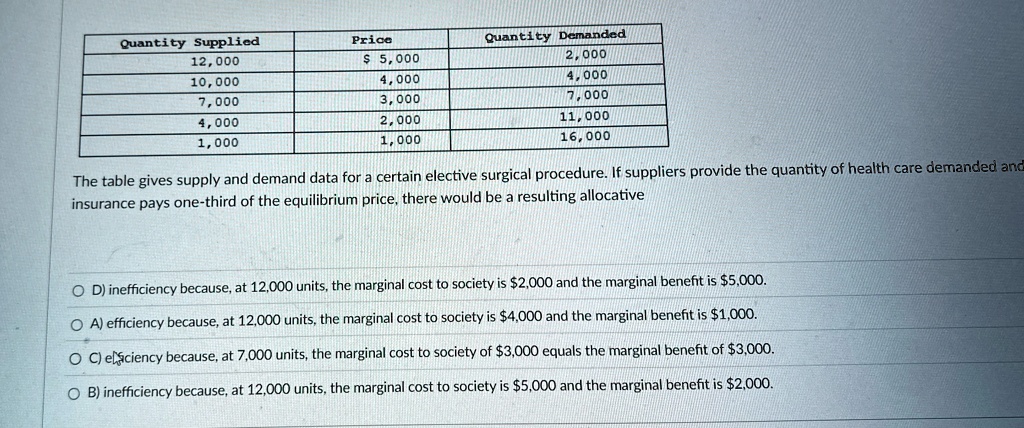
Quantity Supplied Price Quantity Demanded
12,000 $ 5,000 2,000
10,000 4,000 4,000
7,000 3,000 7,000
4,000 2,000 11,000
1,000 1,000 16,000
The table gives supply and demand data for a certain elective surgical procedure. If suppliers provide the quantity of health care demanded and insurance pays one-third of the equilibrium price, there would be a resulting allocative
D) inefficiency because, at 12,000 units, the marginal cost to society is $2,000 and the marginal benefit is $5,000.
A) efficiency because, at 12,000 units, the marginal cost to society is $4,000 and the marginal benefit is $1,000.
C) efficiency because, at 7,000 units, the marginal cost to society of $3,000 equals the marginal benefit of $3,000.
B) inefficiency because, at 12,000 units, the marginal cost to society is $5,000 and the marginal benefit is $2,000.