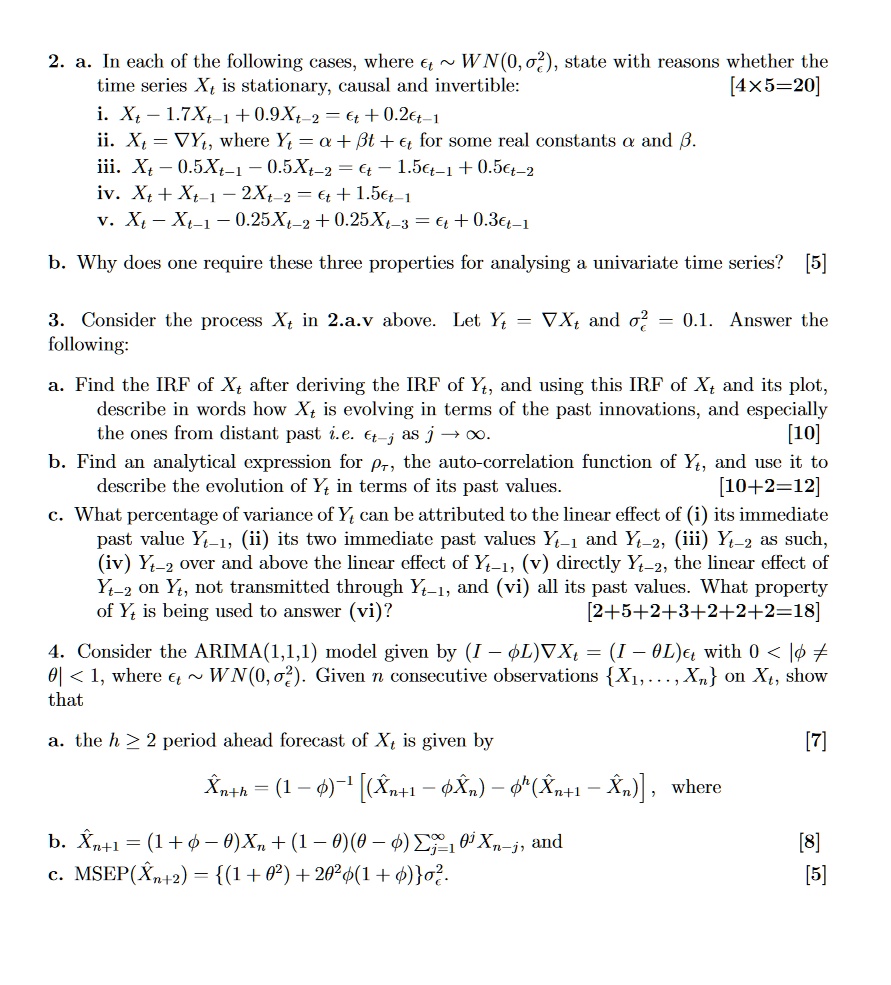
2. a. In each of the following cases, where et ~ WN(0,), state with reasons whether the time series X is stationary, causal and invertible: [4x5=20] i. Xt-1.7Xt-1 +0.9Xt-2=et +0.2et-1 ii. Xt = VYt, where Y = + t + et for some real constants and . iii. X - 0.5Xt-1 - 0.5Xt-2= et - 1.5et-1 + 0.5ct-2 iv. X+ Xt-1-2Xt2=et+1.5et1 v. X - Xt-1 -0.25Xt-2+0.25Xt-3=et +0.3et-1
b. Why does one require these three properties for analyzing a univariate time series? [5]
3. Consider the process Xt in 2.a.v above. Let Y = VX and σ2 = 0.1. Answer the following:
a. Find the IRF of X, after deriving the IRF of Yt, and using this IRF of X, and its plot. describe in words how X, is evolving in terms of the past innovations, and especially the ones from distant past i.e. et-j as i - o. [10] b. Find an analytical expression for P-, the auto-correlation function of Yt, and use it to describe the evolution of Y. in terms of its past values. [10+2=12] c. What percentage of variance of Y can be attributed to the linear effect of (i) its immediate past value Y-1, (ii) its two immediate past values Y--1 and Y-2, (iii) Y-2 as such (iv) Yt-2 over and above the linear effect of Yt-1, (v) directly Yt-2, the linear effect of Y--2 on Yt, not transmitted through Y--1, and (vi) all its past values. What property of Yt is being used to answer (vi)? [2+5+2+3+2+2+2=18]
4. Consider the ARIMA(1,1,1) model given by (1 - oL)VXt = (1 - 6L)et with 0 <| A |< 1, where et ~ WN(0,). Given n consecutive observations {X1,...,Xn} on Xt, show that
a. the h > 2 period ahead forecast of Xt is given by
[]
Xn+h=(1-o)-1|(Xn+1-6Xn)-$h(Xn+1-Xn)] where
b. Xn+1=(1+-0)X+(1-0)(0-)D=0iXn-i, and c. MSEP(Xn+2)={(1+02)+202(1+$)}σ2
[8] [5]