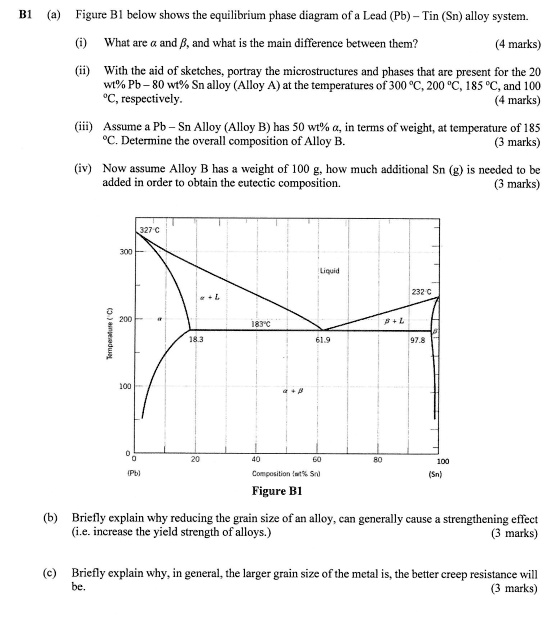
B1 (a) Figure B1 below shows the equilibrium phase diagram of a Lead (Pb) -- Tin (Sn) alloy system.
(i) What are and , and what is the main difference between them?
(4 marks)
(ii) With the aid of sketches, portray the microstructures and phases that are present for the 20 wt% Pb 80 wt% Sn alloy (Alloy A) at the temperatures of 300 C, 200 C, 185 C, and 100 C, respectively. (4 marks)
(iii) Assume a Pb Sn Alloy (Alloy B) has 50 wt% , in terms of weight, at temperature of 185 C. Determine the overall composition of Alloy B. (3 marks)
(iv) Now assume Alloy B has a weight of 100 g, how much additional Sn (g) is needed to be added in order to obtain the eutectic composition. (3 marks)
Liquid
232C
20
183
P+L
8.3
61.9
97.8
20
40 09 Composition (at% Sn) Figure B1
80
100 (Sn)
{Pb}
(b) Briefly explain why reducing the grain size of an alloy, can generally cause a strengthening effect (i.e. increase the yield strength of alloys.) 3 marks
(c) Briefly explain why, in general, the larger grain size of the metal is, the better creep resistance will be. (3 marks)