Ace - AI Tutor
Ask Our Educators
Textbooks
My Library
Flashcards
Scribe - AI Notes
Notes & Exams
Download App
shawn vall-s

shawn v.

Divider

Questions asked

BEST MATCH

Question 9 Determine the most probable length of a line AB, the standard deviation for the following series of taped observations made under the same conditions. Answer with correct significant digits. 99.08 99.14 98.91 99.01 98.99

View Answer
divider
BEST MATCH

On which part of the neuron can we find the nodes of Ranvier? a) Axon b) Neuroglia c) Cell body d) Dendrites

View Answer
divider
BEST MATCH

which of the following molecules is most basic? NH3 NH4+ CF3NH2 HCN

View Answer
divider
BEST MATCH

scientists investigated the relationship between diets with different glycemic loads and the risk of developing coronary heart disease in women.

View Answer
divider
BEST MATCH

Solving Systems Use Gauss-Jordan reduction to transform the augmented matrix of each system in Problems 24-36 to RREF. Use it to discuss the solutions of the system (i.e., no solutions, a unique solution, or infinitel y many solutions). x+y=4 x-y=0 y=2x y=x+3 x+y+z=0 y+z=1 2x+4y-2z=0 5x+3y=0 x-y-2z=1 2x+3y+z=2 5x+4y+2z=4 x_(1)+4x_(2)-5x_(3)=0 2x_(1)-x_(2)+8x_(3)=9 x+z=2 2x-3y+5z=4 3x+2y-z=4 x_(1)+x_(2)+2x_(3)=0 2x_(1)-x_(2)+x_(3)=0 4x_(1)+x_(2)+5x_(3)=0 x+2y+z=2 2x-4y-3z=0 -x+6y-4z=2 x-y=4 x-y+z=0 x+y=0 x+2y-z=0 x_(1)+x_(2)+2x_(3)=1 2x_(1)-x_(2)+x_(3)=2 4x_(1)+x_(2)+5x_(3)=4 x+2y+z=2 x-y=4 2x-y+2z=0 3y+z=-2 +2x_(3)-4x_(4)=1 x_(2)+x_(3)-3x_(4)=2 Using the Nonhomogeneous Principle Determine the solu- tion set W for the associated homogeneous systems in Prob- lems 37-49. Then write the solutions to the systems in the original problems in the form vec(x)=vec(x)_(p)+vec(x)_(h), where vec(x)_(h)inW. Problem 24 Problem 25 Problem 26 Problem 27 Problem 28 Problem 29 Problem 30 Problem 31 Problem 32 Problem 33 Problem 34 Problem 35 Problem 36 Plz do 37-49 thanks Pla Solving Systems Use Gauss-Jordan reduction to transform the augmented matrix of each system in Problems 24-36 to RREF. Use it to discuss the solutions of the system (i.e., no solutions, a unique solution, or infinitely many solutions). 24. x + y = 4 25. y=2x x-y=0 y=x+3 26.x+y+z=0 y+z=1 27. 2x+4y-2z=0 5x + 3y =0 28.x - y - 2z = 1 2x+3y+z=2 5x +4y+2z= 4 29. x+4x2-5x3=0 2xi- x2+8x3=9 30.x +z=2 2x-3y+ 5z=4 3x+ 2y- z=4 31. x- y+z=0 x+ y=0 x+2y-z=0 32.x1 +x2 + 2x3=0 2x1-x2+x3=0 4xi+x2+5x3=0 33. xi+ x2+2x3=1 2x1-x2+x3=2 4xi + x2 +5x3=4 34. x+2y+z=2 2x-4y- 3z=0 -x +6y-4z=2 x- y =4 35. x+2y+z= 2 x- y = 4 2x-y+2z= 0 3y+ z=-2 36. xi +2x3-4x4=1 x2+x3-3x4=2 Using the Nonhomogeneous Principle Determine the solu- tion set W for the associated homogeneous systems in Prob- lems 37-49. Then write the solutions to the systems in the original problems in the form i = &p + xn. where x, e W. 37. Problem 24 38. Problem 25 39. Problem 26 40. Problem 27 41. Problem 28 42. Problem 29 43. Problem 30 44. Problem 31 45. Problem 32 46. Problem 33 47. Problem 34 48. Problem 35 49. Problem 36
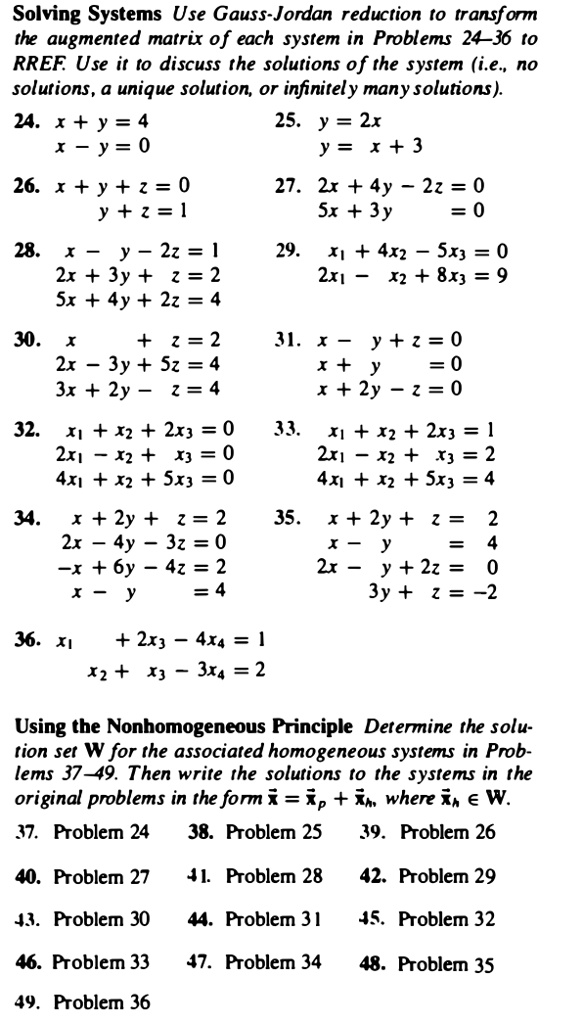
View Answer
divider
BEST MATCH

If the percentage change in the quantity demanded of a good is greater than the percentage change in price, price elasticity of demand is: Group of answer choices elastic. inelastic. perfectly inelastic. perfectly elastic.

View Answer
divider
BEST MATCH

DETAILS LARCALC11 13.6.035. Find the gradient of the function at the given point. Function Point f(x, y, z) = \sqrt{x^2 + y^2 + z^2} (9, 4, 8) \nabla f(9, 4, 8) = Find the maximum value of the directional derivative at the given point.

View Answer
divider
BEST MATCH

7. Flood the fibers (situated under the stereomicroscope) with several drops of the solution containing ATP, K+, and Mg2+. Watch the reaction of the fibers after adding the solution. After 30 seconds (or slightly longer), remeasure each fiber and record the observed ending lengths on the chart. Calculate the percentage of contraction by using the simple formula below, and record this data on the chart. Initial \\ length (mm) \\ - ending \\ length (mm) = net \\ change (mm) then: $\frac{\text{net change (mm)}}{\text{initial length (mm)}} \times 100 = $ ____ % contraction

View Answer
divider
BEST MATCH

Calculate the node voltages in the circuit shown in Fig.Q1, V1 (in V) (in V) ? 20 ? + $V_x$ 30 ? #1 20 ? #2 + 1.5 A? 10 ? $2v_x$ 10 ? ? 3 A * Please provide your answers to four significant figures. V2

View Answer
divider
BEST MATCH

A pitcher throws a 0.200 kg ball so that its speed is 12.0 m/s and angle is 40.0\textdegree below the horizontal when a player bats the ball directly toward the pitcher with velocity 50.0 m/s at 30.0\textdegree above the horizontal. Assume $+\hat{i}$ to be along the line from the batter to the pitcher and $+\hat{j}$ to be the upward vertical direction. (Express your answers in vector form.) (a) Determine the impulse (in N\textcdot s) delivered to the ball. $\vec{I} = (10.6\hat{i} + 6.38\hat{j})$ Write the impulse-momentum equations for the horizontal and vertical components of the ball. Make sure to note that the angle of the initial velocity is negative. Combine your results to write the vector equation. Be careful of your signs. N\textcdot s (b) If the force on the ball increases linearly for 4.00 ms, holds constant for 20.0 ms, and then decreases linearly to zero in another 4.00 ms, what is the maximum force (in N) on the ball? $\vec{F}_{\text{max}} = (443\hat{i} + 267\hat{j})$ Find the average impulse for the three time intervals in terms of the maximum force, take the sum, and set your result equal to the impulse equation found in part (a). N

View Answer
divider