Ace - AI Tutor
Ask Our Educators
Textbooks
My Library
Flashcards
Scribe - AI Notes
Notes & Exams
Download App
shawn wang

shawn w.

Divider

Questions asked

BEST MATCH

A Taxpayer who earned $200,000 or more (in 2024) must choose the itemized deduction. O True O False

View Answer
divider
BEST MATCH

When criticizing someone in a one-on-one meeting, you should always ensure that the criticism is: ? innovative ? constructive ? destructive ? oppressive

View Answer
divider
BEST MATCH

Apparent weight of a 130.1 N object when it is fully submerged in a fluid is 63.8 N. What is the buoyant force acting on this object? Keep one decimal point.

View Answer
divider
BEST MATCH

5. Calculating WACC Croft Corporation has a target capital structure of 80 percent common stock and 20 percent debt. Its cost of equity is 10.9 percent, and the cost of debt is 4.7 percent. The tax rate is 21 percent. What is the company's WACC?

View Answer
divider
BEST MATCH

Whereas Mendel had formulated the law of independent assortment, Morgan realized that instead of random segregation, sometimes genes that are located proximate to one another on a chromosome tend to remain together. true or false

View Answer
divider
BEST MATCH

Question 19 (1 point) Listen Countries that pursued export-led growth (i.e., outward-oriented) policies in the 20th century experienced lower rates of economic growth than did countries that pursued inward-oriented policies. include Japan, Singapore, South Korea, and Taiwan. All of the above are correct. experienced higher levels of political instability than did countries that pursued inward-oriented policies.

View Answer
divider
BEST MATCH

Consider all the 11 observations in the table below. The data is from a 2 factor factorial experiment. Factor 2 Factor 1 1 2 3 1 14 8 7 2 10 19 6 3 --- 17 22 4 3 9 10 1.1 Write down the equation of the general model without an interaction term for this data. 1.2 Write down the equation of the general model with the interaction term for this data. (4) (4) 1.3 Write down the normal equations for the no interaction model in part 1.1. 1.4 Find the solutions to the normal equations for the no interaction model in part 1.1. (8) (8)

View Answer
divider
BEST MATCH

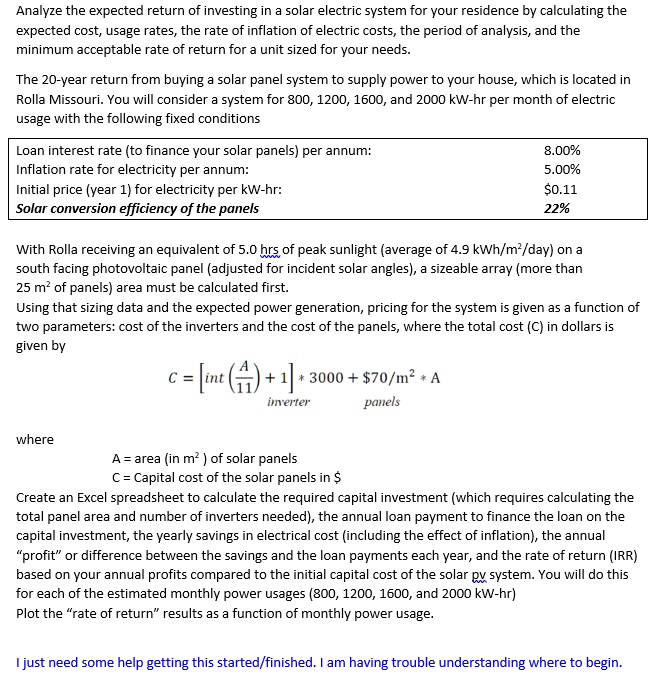
Analyze the expected return of investing in a solar electric system for your residence by calculating the expected cost, usage rates, the rate of inflation of electric costs, the period of analysis, and the minimum acceptable rate of return for a unit sized for your needs. The 20-year return from buying a solar panel system to supply power to your house, which is located in Rolla Missouri. You will consider a system for 800, 1200, 1600, and 2000 kW-hr per month of electric usage with the following fixed conditions Loan interest rate (to finance your solar panels) per annum: Inflation rate for electricity per annum: Initial price (year 1) for electricity per kW-hr: Solar conversion efficiency of the panels 8.00% 5.00% $0.11 22% With Rolla receiving an equivalent of 5.0 hrs of peak sunlight (average of 4.9 kWh/m²/day) on a south facing photovoltaic panel (adjusted for incident solar angles), a sizeable array (more than 25 m² of panels) area must be calculated first. Using that sizing data and the expected power generation, pricing for the system is given as a function of two parameters: cost of the inverters and the cost of the panels, where the total cost (C) in dollars is given by $$C = \int \left(\frac{A}{11} + 1\right) * 3000 + \$70/m^2 * A$$ where A = area (in m²) of solar panels C = Capital cost of the solar panels in $ Create an Excel spreadsheet to calculate the required capital investment (which requires calculating the total panel area and number of inverters needed), the annual loan payment to finance the loan on the capital investment, the yearly savings in electrical cost (including the effect of inflation), the annual "profit" or difference between the savings and the loan payments each year, and the rate of return (IRR) based on your annual profits compared to the initial capital cost of the solar pv system. You will do this for each of the estimated monthly power usages (800, 1200, 1600, and 2000 kW-hr) Plot the "rate of return" results as a function of monthly power usage. I just need some help getting this started/finished. I am having trouble understanding where to begin.
View Answer
divider
BEST MATCH

Which of the following does not explain why multiple pathways are needed for the activation and suppression of chemical mediators? The chemical mediators are so potent Autoimmunity can occur if unregulated Healing requires multiple chemical mediators The response must be overzealous to be effective

View Answer
divider
BEST MATCH

Two resistors r and R are connected in series across a 100-V line. If r=30kΩ and the voltage across it is found to be 60V, find the resistance of R. Answer: 20kΩ. In the figure, R_(1)=2.0Ω,R_(2)=4.0Ω,R_(3)=8.0Ω,ε_(1)=2.0Ω,ε_(2)=4.0Ω, and ε_(3)=6.0Ω. What is the rate of energy dissipation in R_(1)? Answer: 0.32W. Two resistors r and R are connected in series across a 100-V line. If r = 30 kΩ and the voltage across it is found to be 60 V, find the resistance of R. Answer: 20 kΩ. In the figure, R_(1)=2.0Ω,R_(2)=4.0Ω,R_(3)=8.0Ω,ε_(1)=2.0Ω,ε_(2)=4.0Ω, and ε_(3)=6.0Ω. What is the rate of energy dissipation in R_(1)? Answer: 0.32W.

View Answer
divider