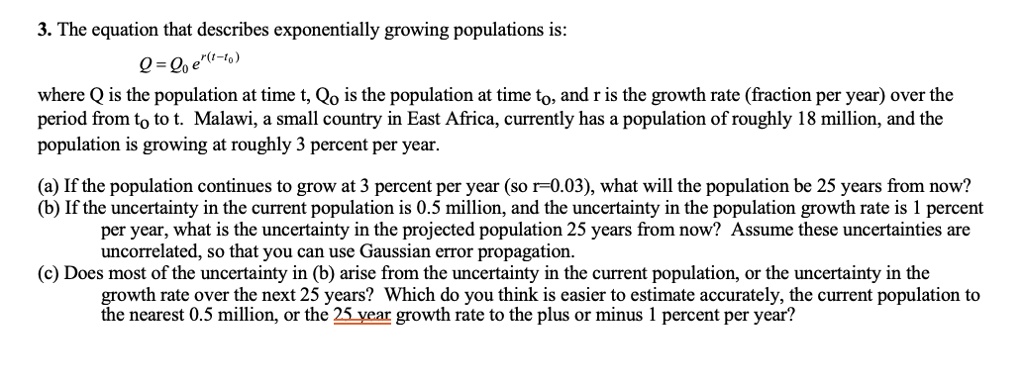
3. The equation that describes exponentially growing populations is:
$Q = Q_0e^{r(t-t_0)}$
where Q is the population at time t, Qo is the population at time to, and r is the growth rate (fraction per year) over the
period from to to t. Malawi, a small country in East Africa, currently has a population of roughly 18 million, and the
population is growing at roughly 3 percent per year.
(a) If the population continues to grow at 3 percent per year (so r=0.03), what will the population be 25 years from now?
(b) If the uncertainty in the current population is 0.5 million, and the uncertainty in the population growth rate is 1 percent
per year, what is the uncertainty in the projected population 25 years from now? Assume these uncertainties are
uncorrelated, so that you can use Gaussian error propagation.
(c) Does most of the uncertainty in (b) arise from the uncertainty in the current population, or the uncertainty in the
growth rate over the next 25 years? Which do you think is easier to estimate accurately, the current population to
the nearest 0.5 million, or the 25 year growth rate to the plus or minus 1 percent per year?