(a) Calculate the Higher Heating Value, HHV, and Lower Heating Value, LHV, of the fuel gas in kJ/kg.
(b) Determine the adiabatic flame temperature.
(c) List three factors that will have a significant effect on the adiabatic flame temperature and briefly discuss your answers.
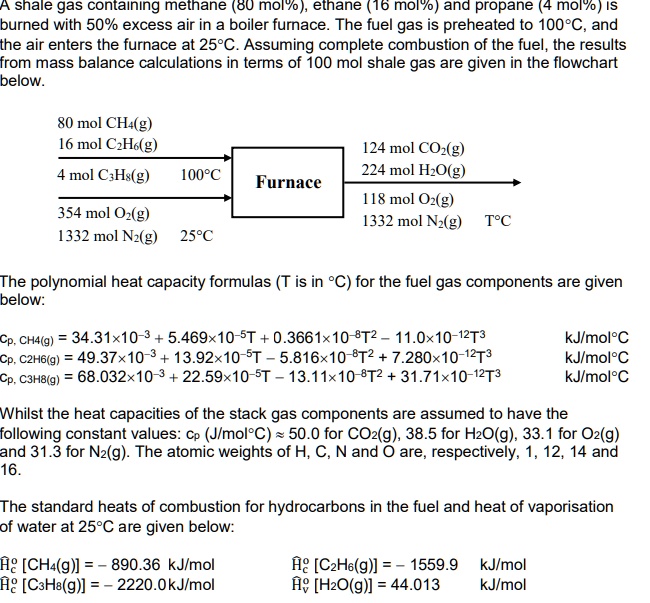
The fuel gas is burned with 50% excess air in a boiler furnace. The fuel gas is preheated to 100°C, and the air enters the furnace at 25°C. Assuming complete combustion of the fuel, the results from mass balance calculations in terms of 100 mol shale gas are given in the flowchart below.
80 mol CH4(g)
16 mol C2H6(g)
124 mol CO2(g)
224 mol H2O(g)
118 mol O2(g)
1332 mol N2(g)
TC
4 mol CH4(g)
100
Furnace
354 mol O2(g)
1332 mol N2(g)
25°C
The polynomial heat capacity formulas (T is in °C) for the fuel gas components are given below:
Cp, CH4(g) = 34.3110-3 + 5.46910-5T + 0.366110-T2 - 11.010-12T3
Cp, C2H6(g) = 49.3710-3 + 13.9210-5T - 5.81610-8T2 + 7.28010-12T3
Cp, C3H(g) = 68.03210-3 + 22.5910-5T - 13.1110-8T2 + 31.7110-12T3
kJ/mol°C kJ/mol°C kJ/mol°C
While the heat capacities of the stack gas components are assumed to have the following constant values: cp(J/mol°C) = 50.0 for CO2(g), 38.5 for H2O(g), 33.1 for O2(g), and 31.3 for N2(g). The atomic weights of H, C, N, and O are, respectively, 1, 12, 14, and 16.
The standard heats of combustion for hydrocarbons in the fuel and heat of vaporization of water at 25°C are given below:
ΔH[CH4(g)] = -890.36 kJ/mol
ΔH[C3Hs(g)] = -2220.0 kJ/mol
ΔH[C2H6(g)] = -1559.9 kJ/mol
ΔH[H2O(g)] = 44.013 kJ/mol