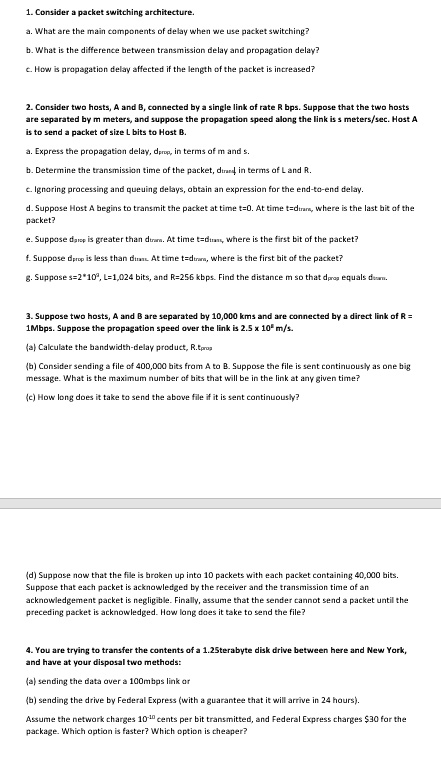
1. Consider a packet switching architecture.
b. What is the difference between transmission delay and propagation delay?
c. How is propagation delay affected if the length of the packet is increased?
2. Consider two hosts, A and B, connected by a single link of rate R bps. Suppose that the two hosts are separated by m meters, and suppose the propagation speed along the link is s meters/sec. Host A is to send a packet of size L bits to Host B.
a. Express the propagation delay, dprop, in terms of m and s.
b. Determine the transmission time of the packet, dtrans, in terms of L and R.
c. Ignoring processing and queuing delays, obtain an expression for the end-to-end delay.
d. Suppose Host A begins to transmit the packet at time t=0. At time t=dtrans, where is the last bit of the packet?
e. Suppose dprop is greater than dtrans. At time t=dtrans, where is the first bit of the packet?
f. Suppose dprop is less than dtrans. At time t=dtrans, where is the first bit of the packet?
g. Suppose s=2*10^3, L=1,024 bits, and R=256 kbps. Find the distance m so that dprop equals dtrans.
3. Suppose two hosts, A and B are separated by 10,000 kms and are connected by a direct link of R = 1Mbps. Suppose the propagation speed over the link is 2.5 x 10^8 m/s.
(a) Calculate the bandwidth-delay product, R.tprop.
(b) Consider sending a file of 400,000 bits from A to B. Suppose the file is sent continuously as one big message. What is the maximum number of bits that will be in the link at any given time?
(c) How long does it take to send the above file if it is sent continuously?
(d) Suppose now that the file is broken up into 10 packets with each packet containing 40,000 bits. Assume the time taken for an acknowledgement packet is negligible. Finally, assume that the sender cannot send a packet until the preceding packet is acknowledged. How long does it take to send the file?
4. You are trying to transfer the contents of a 1.25 terabyte disk drive between here and New York, and have at your disposal two methods:
(a) sending the data over a 100mbps link or
(b) sending the drive by Federal Express (with a guarantee that it will arrive in 24 hours)
Assume the network charges 10^-1 cents per bit transmitted, and Federal Express charges $30 for the package. Which option is faster? Which option is cheaper?