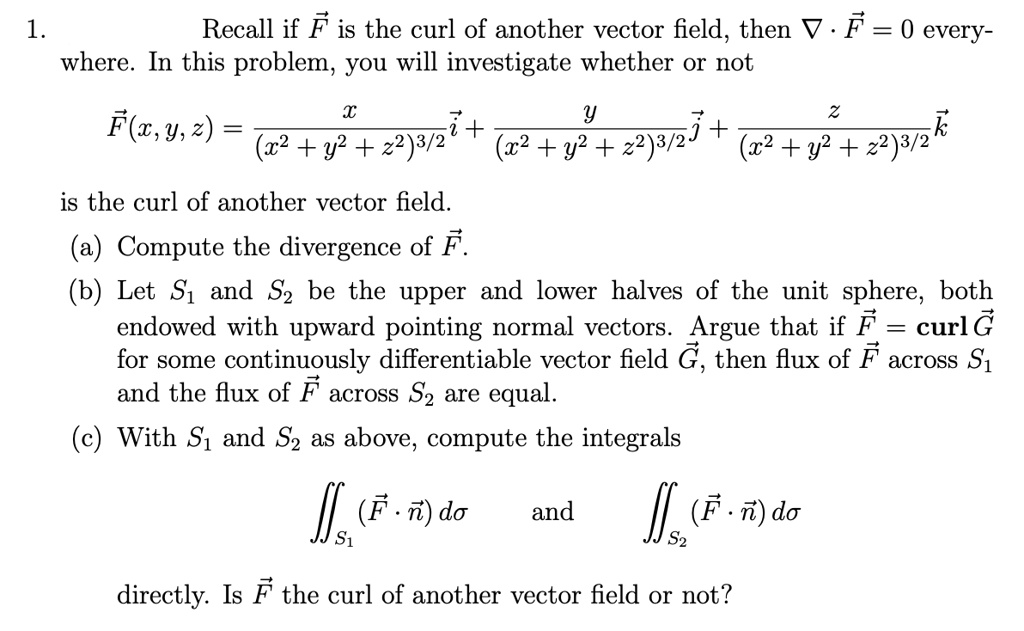
1. Recall if vec{F} is the curl of another vector field, then
abla cdot vec{F} = 0 everywhere. In this problem, you will investigate whether or not
vec{F}(x, y, z) = frac{x}{(x^2 + y^2 + z^2)^{3/2}}vec{i} + frac{y}{(x^2 + y^2 + z^2)^{3/2}}vec{j} + frac{z}{(x^2 + y^2 + z^2)^{3/2}}vec{k}
is the curl of another vector field.
(a) Compute the divergence of vec{F}.
(b) Let S_1 and S_2 be the upper and lower halves of the unit sphere, both endowed with upward pointing normal vectors. Argue that if vec{F} = curlvec{G} for some continuously differentiable vector field vec{G}, then flux of vec{F} across S_1 and the flux of vec{F} across S_2 are equal.
(c) With S_1 and S_2 as above, compute the integrals
iint_{S_1} (vec{F} cdot vec{n}) dsigma quad ext{and} quad iint_{S_2} (vec{F} cdot vec{n}) dsigma
directly. Is vec{F} the curl of another vector field or not?