66
Laboratory Manual for Human Biology
Do you think the thoracic cavity changes size
and shape during breathing, or remains fixed in
size and shape?
Why or why not?
look at the blood vessels attached to the kid-
neys, speculate as to why the "kidney punch" is
illegal in boxing.
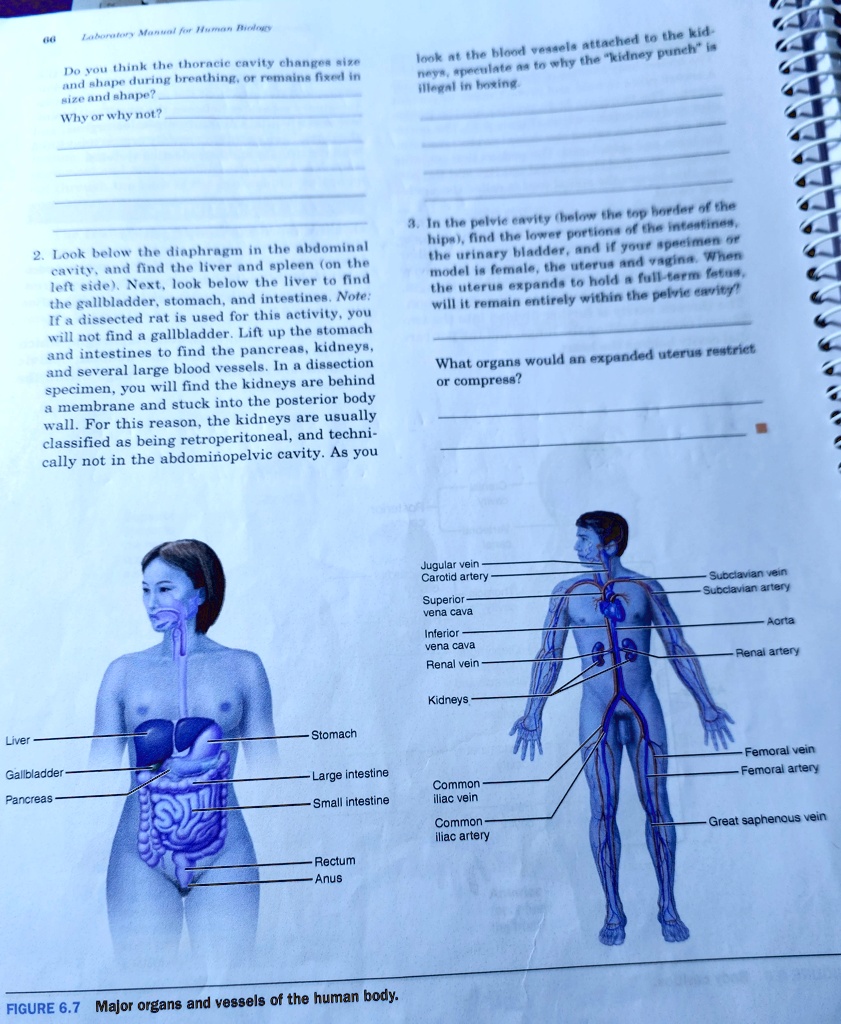
2. Look below the diaphragm in the abdominal
cavity, and find the liver and spleen (on the
left side). Next, look below the liver to find
the gallbladder, stomach, and intestines. Note:
If a dissected rat is used for this activity, you
will not find a gallbladder. Lift up the stomach
and intestines to find the pancreas, kidneys,
and several large blood vessels. In a dissection
specimen, you will find the kidneys are behind
a membrane and stuck into the posterior body
wall. For this reason, the kidneys are usually
classified as being retroperitoneal, and techni-
cally not in the abdominopelvic cavity. As you
3. In the pelvic cavity (below the top border of the
hips), find the lower portions of the intestines,
the urinary bladder, and if your specimen or
model is female, the uterus and vagina. When
the uterus expands to hold a full-term fetus,
will it remain entirely within the pelvic cavity?
What organs would an expanded uterus restrict
or compress?
Liver
Gallbladder
Pancreas
Jugular vein
Carotid artery
Superior
vena cava
Inferior
vena cava
Renal vein
Subclavian vein
Subclavian artery
Aorta
Renal artery
Kidneys
Stomach
Large intestine
Small intestine
Rectum
Anus
FIGURE 6.7 Major organs and vessels of the human body.
Common
iliac vein
Common
iliac artery
Femoral vein
Femoral artery
Great saphenous vein