Ace - AI Tutor
Ask Our Educators
Textbooks
My Library
Flashcards
Scribe - AI Notes
Notes & Exams
Download App
shelby sanchez

shelby s.

Divider

Questions asked

BEST MATCH

Which of the following is a characteristic of archaea but NOT bacteria? genes may contain introns The presence of mitochondria widely known to cause disease 70S ribosomes A plasma membrane cell walls are composed of peptidoglycan

View Answer
divider
BEST MATCH

Which of these terms applies to the excess of sales over cost of goods sold? O gross profit O net income O operations O gross sales

View Answer
divider
BEST MATCH

In the beef market, what happens when: The government places a large tax on beef producers. A. Demand shifts right, P rises and Q rises B. Supply shifts left, P rises and Q falls C. Supply shifts right, P falls and Q rises D. Demand shifts left, P falls and Q falls

View Answer
divider
BEST MATCH

Can you explain more detailed and clearly each part Near an electric point charge in a vacuum, all points on the dashed line below have the same electric potential +9V with respect to a very distant reference point. For the exact description of the situation, the sketched Cartesian coordinate system with the scale division of 1m is used, in which, among other things, the points A and B with the coordinates xA = -1m, yA = 2m and xB = 1m, yB = 2m are of interest. Note ε0 = 8.85 x 10^-12 As/Vm a) Briefly explain why the field-generating point charge q is not at the origin of the sketch below! b) Determine the magnitude of the charge |q|. Is q a positive charge or a negative charge? Explain briefly! c) What is the magnitude of the electric field strength |E| and |E| at the points A and B? Enter the directions of the electric field strength vectors E and E at these points in the sketch below. d) Draw in the following sketch the equipotential line whose points have the potential = 2+18V with respect to a very distant reference point. y/m Points at a potential of = +9V - x/m

View Answer
divider
BEST MATCH

Contemporary engineering companies use a range of tools and techniques to enable them to diagrammatic representation of a major capital project concerned with the introduction of a new industrial crane, at time Tn in its implementation. Figure 2 COST100s) Estimated cost to completion 120 120 110 100 10 100 90 08 70 60 50 40 90 Estimated time to completion BCWS ACWP 20 BCWP 10 TIME(months) Tn Planned date for completion a) Discuss and contrast Traditional approaches to project performance measurement using an actual versus budget methodology as opposed to the 'Earned Value Management (EVM) technique exemplified within Figure 2. [6 marks] b) Interpret and explain the performance-related information provided in Figure 2, and show using examples how selected ratio-based indices can be additionally used to highlight the performance to date and the future outcome of the project. [9 marks] c) Easy-Lift Limited is a global industrial crane manufacturer, based in the United Kingdom and supplies design-to-order industrial warehouse cranes throughout the world. Its cranes briefly comprise: main steel cross beam, two identical powered legs, a central moveable hoist to lift materials, and an electronic controller. For each crane manufacture and installation, a project approach is adopted whereby Easy-Lift works with its customer and its two main suppliers (Steel and Hoist) to ensure implementation success. Briefly describe how Easy-Lift could implement a combined EVA-based performance monitoring risk management and communication approach with its stakeholders for the improvement of its business? [10 marks] Page 5 of 7

View Answer
divider
BEST MATCH

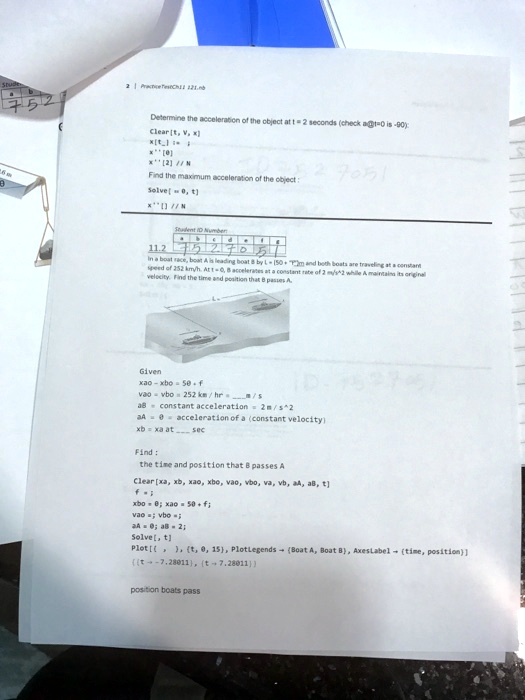
Determine the acceleration of the object at t = 2 seconds (check a@t=0 is -90): Clear[t, v, x] x[t] x[0] x[2]//N Find the maximum acceleration of the object: Solve[0, t] x[]//N In a boat race, boat A is leading boat B by L = 50 "m" and both boats are traveling at a constant speed of 252 km/h. At t = 0, B accelerates at a constant rate of 2 m/s^2 while A maintains its original velocity. Find the time and position that B passes A. Given xa0 - xb0 = 50 f va0 = vb0 = 252 km/hr = m/s aB = constant acceleration = 2 m/s^2 aa = 0 = acceleration of a (constant velocity) xb = xa at = sec Find: the time and position that B passes A Clear[xa, xb, xa0, xb0, va0, vb0, va, vb, aa, aB, t] f; xb0 = 0; xa0 = 50 + f; va0 = vb0; aa = 0; aB = 2; Solve[, t] Plot[( , ), {t, 0, 15}, PlotLegends -> {Boat A, Boat B}, AxesLabel -> {time, position}] {(t - 7.28011), (t - 7.28011)} position boats pass
View Answer
divider
BEST MATCH

Question 7 0.3 pts What is $m_{max}$, the highest-order maximum for 400 nm = $4.0 \times 10^{-7}$ m light falling on double slits separated by 25.0 µm = $2.5 \times 10^{-5}$ m? 60 62 64 66

View Answer
divider
BEST MATCH

3. Determine which input-output systems given below are (i) homogeneous, (ii) additive, and (iii) linear. (a) $y(t) = \int_0^t x(t - \tau)x(\tau)d\tau$ (b) $y(t) = 4t\frac{dx}{dt} - 2x(t)$ (c) $y(t) = (x^3(t) + x^3(t - 2))^{\frac{1}{3}}$ (d) $y(t) = e^{-t}x(t - 1)$

View Answer
divider
BEST MATCH

A force of F = (2xi - 4yj) N is applied to a 10-kg object on a plane. The object moved from an initial location of (3m, -5m) to a final location (-6m, 7m). Find the work done by the force.

View Answer
divider
BEST MATCH

Perform 2 iterations of the bisection method to find the root of f(x) = x*cos(x) – 0.2 with lower and upper bounds of -1 and 1.4, respectively. After doing two full iterations, what would your next guess of Xr be? a. -0.7 b. -0.1 c. 0.2 d. 0.5 e. 0.8 Please provide neat and correct solution for bisection method here, Thumbs up for neatness and step by step solution ( option d is correct)

View Answer
divider