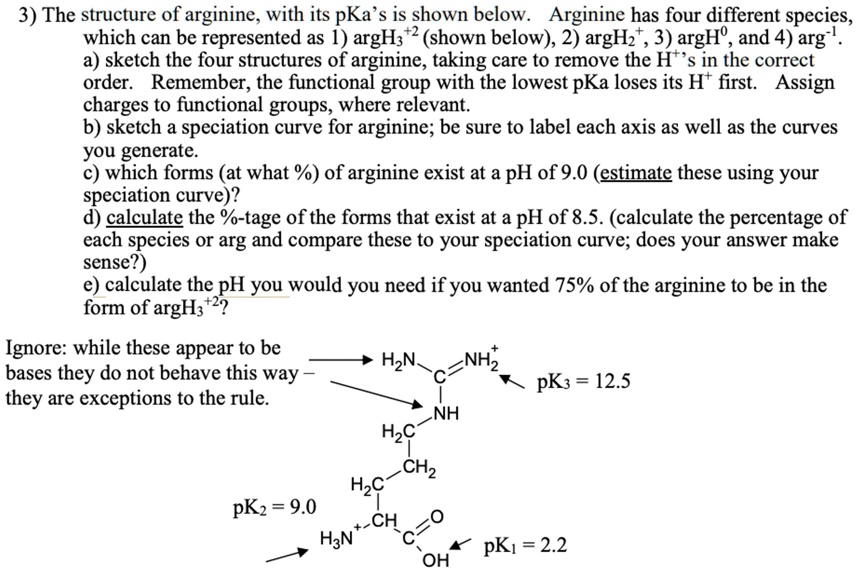
3) The structure of arginine, with its pKa's is shown below. Arginine has four different species, which can be represented as 1) argH$_3$$^{+2}$ (shown below), 2) argH$_2$$^{+}$, 3) argH$^0$, and 4) arg$^{-1}$.
a) sketch the four structures of arginine, taking care to remove the H$^+$'s in the correct order. Remember, the functional group with the lowest pKa loses its H$^+$ first. Assign charges to functional groups, where relevant.
b) sketch a speciation curve for arginine; be sure to label each axis as well as the curves you generate.
c) which forms (at what %) of arginine exist at a pH of 9.0 (estimate these using your speciation curve)?
d) calculate the %-tage of the forms that exist at a pH of 8.5. (calculate the percentage of each species or arg and compare these to your speciation curve; does your answer make sense?)
e) calculate the pH you would you need if you wanted 75% of the arginine to be in the form of argH$_3$$^{+2}$?
Ignore: while these appear to be bases they do not behave this way they are exceptions to the rule.