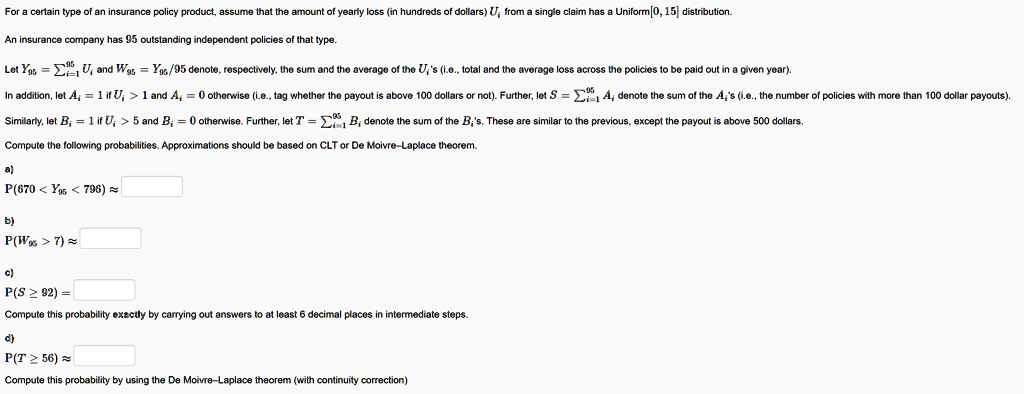
For a certain type of an insurance policy product, assume that the amount of yearly loss (in hundreds of dollars) $U_i$ from a single claim has a Uniform$[0, 15]$ distribution.
An insurance company has 95 outstanding independent policies of that type.
Let $Y_{95} = \sum_{i=1}^{95} U_i$ and $W_{95} = Y_{95}/95$ denote, respectively, the sum and the average of the $U_i$'s (i.e., total and the average loss across the policies to be paid out in a given year).
In addition, let $A_i = 1$ if $U_i > 1$ and $A_i = 0$ otherwise (i.e., tag whether the payout is above 100 dollars or not). Further, let $S = \sum_{i=1}^{95} A_i$ denote the sum of the $A_i$'s (i.e., the number of policies with more than 100 dollar payouts).
Similarly, let $B_i = 1$ if $U_i > 5$ and $B_i = 0$ otherwise. Further, let $T = \sum_{i=1}^{95} B_i$ denote the sum of the $B_i$'s. These are similar to the previous, except the payout is above 500 dollars.
Compute the following probabilities. Approximations should be based on CLT or De Moivre-Laplace theorem.
a)
$P(670 < Y_{95} < 796) \approx$
b)
$P(W_{95} > 7) \approx$
c)
$P(S \ge 92) =$
Compute this probability exactly by carrying out answers to at least 6 decimal places in intermediate steps.
d)
$P(T \ge 56) \approx$
Compute this probability by using the De Moivre-Laplace theorem (with continuity correction)