Ace - AI Tutor
Ask Our Educators
Textbooks
My Library
Flashcards
Scribe - AI Notes
Notes & Exams
Download App
shelley fletcher

shelley f.

Divider

Questions asked

BEST MATCH

1. Explain, in your own words, what we mean by a steady state growth rate. Does it correspond to a situation where the economy is no longer growing?

View Answer
divider
BEST MATCH

The structure that prevents swallowed food from entering the lungs is the Blank______.

View Answer
divider
BEST MATCH

Ethylene can be produced in a continuous dehydrogenation process at steady state. $C_2H_6 -> C_2H_4 + H_2$ $C_2H_6 + H_2 -> 2CH_4$ The feed contains 85.0 mole% ethane ($C_2H_6$) and the balance inerts (I). The fractional conversion of ethane is 0.501, and the selectivity of ethylene to methane is 7.7. Calculate the molar composition of the product gas and the fractional yield of ethylene.

View Answer
divider
BEST MATCH

If a reaction is exothermic and produces large quantities of heat reaching equilfrium, its equilibrium constant will be View Available Hint(s) zero, because the reaction will not have an equilibrium constant. negative, because it is an exothermic reaction. greater than zero. Submit Part D Consider the reaction \[ \mathrm{N}_{2} \mathrm{O}_{4}(\mathrm{~g}) \rightarrow 2 \mathrm{NO}_{2}(\mathrm{~g}) \] where \( \mathrm{N}_{2} \mathrm{O}_{4} \) is colorless and \( \mathrm{NO}_{2} \) is brown. At a temperature of \( 5^{\circ} \mathrm{C} \) the reaction is colorless at equilibrium. This constant for this reaction at this temperature is

View Answer
divider
BEST MATCH

12:30 PM Sun Sep 15 ati student.atitesting.com Custom: UMHB N1 Anemia Quiz Cohort: 05/26 Question: 3 of 17 Time Remaining: 100% 08:17:23 PAUSE Pause Remaining: 00:05:00 CLOSE FLAG A nurse is providing teaching about dietary recommendations to a client who has iron deficiency anemia. Which of the following dietary recommendations should the nurse include as a food that enhances iron absorption when consumed with nonheme iron? Tomato juice Tea Milk Dried beans PREVIOUS CONTINUE

View Answer
divider
BEST MATCH

Sorry, I cannot fulfill your request.

View Answer
divider
BEST MATCH

You want to obtain a sample to estimate a population mean. Based on previous evidence, you believe the population standard deviation is approximately $\sigma = 23.5$. You would like to be 95\% confident that your estimate is within 5 of the true population mean. How large of a sample size is required? [Do not round mid-calculation. However, use a critical value rounded to three decimal places - this is important for the system to check answers correctly.] n =

View Answer
divider
BEST MATCH

The Laplace inverse of $\frac{s}{s^2 - 1}$ is, i.e., $\mathcal{L}^{-1} \left( \frac{s}{s^2 - 1} \right)$ a) cosh t b) sinh t c) cost d) sint

View Answer
divider
BEST MATCH

3. Let T be exponentially distributed with mean 5 minutes. Let \(\tilde{T}\) be the same lenght of time except measured in hours. Determine the following: (a) The p.d.f. of T. (b) The probability that T is greater than 10 minutes. (c) The probability that T equals 10 minutes. (d) The variance of T (including units). (e) The squared coefficient of variation of T. (f) The probability that T is greater than 15 minutes given that T is greater than 5 minutes. (g) The Laplace-Stieltjes transform of T; i.e., \(L(s) = E[e^{-sT}]\). (The L-S transform can be used to find means and higher moments of nonnegative random variables similar to how the p.g.f. of nonnegative, integer-valued random variables can be used to compute those quantities.) (h) The distribution of \(\tilde{T}\) including any parameters. (i) The squared coefficient of variation of \(\tilde{T}\).

View Answer
divider
BEST MATCH

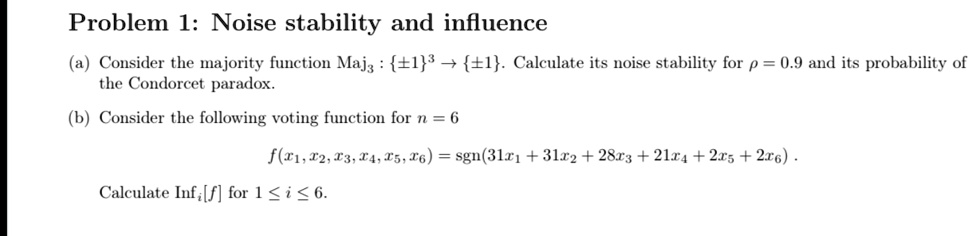
Problem 1: Noise stability and influence (a) Consider the majority function Maj$_3$ : {$\pm$1}$^3 \to$ {$\pm$1}. Calculate its noise stability for $p = 0.9$ and its probability of the Condorcet paradox. (b) Consider the following voting function for $n = 6$ $f(x_1, x_2, x_3, x_4, x_5, x_6) = sgn(31x_1 + 31x_2 + 28x_3 + 21x_4 + 2x_5 + 2x_6)$. Calculate Inf$_i$[f] for $1 \le i \le 6$.
View Answer
divider