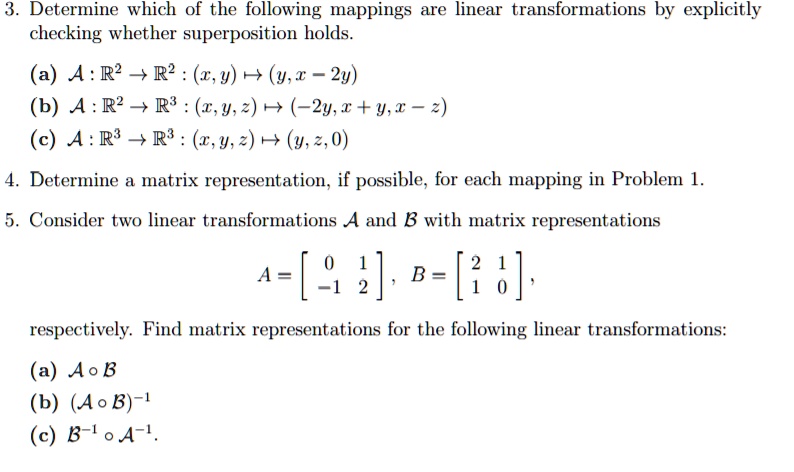
3. Determine which of the following mappings are linear transformations by explicitly
checking whether superposition holds.
(a) $A: \mathbb{R}^2 \to \mathbb{R}^2: (x, y) \mapsto (y, x - 2y)$
(b) $A: \mathbb{R}^2 \to \mathbb{R}^3: (x, y, z) \mapsto (-2y, x + y, x - z)$
(c) $A: \mathbb{R}^3 \to \mathbb{R}^3: (x, y, z) \mapsto (y, z, 0)$
4. Determine a matrix representation, if possible, for each mapping in Problem 1.
5. Consider two linear transformations $A$ and $B$ with matrix representations
$\begin{aligned}
A &= \begin{bmatrix} 0 & 1 \ -1 & 2 \end{bmatrix}, \quad B = \begin{bmatrix} 2 & 1 \ 1 & 0 \end{bmatrix},
\end{aligned}$
respectively. Find matrix representations for the following linear transformations:
(a) $A \circ B$
(b) $(A \circ B)^{-1}$
(c) $B^{-1} \circ A^{-1}$.