Ace - AI Tutor
Ask Our Educators
Textbooks
My Library
Flashcards
Scribe - AI Notes
Notes & Exams
Download App
sherri chavez

sherri c.

Divider

Questions asked

BEST MATCH

Which of the following statements about tax is the most accurate? Select one: The marginal and effective tax rates are often different The effective tax rate is the tax paid divided by profit before tax Tax expense is the amount of liability on the balance sheet at the end of the period Tax expense is the amount paid during the period

View Answer
divider
BEST MATCH

tions and Inequalities Other than a no solution set. use interval not. 2x+4<10

View Answer
divider
BEST MATCH

Research suggests that the impact of the low-activity version of the $MAOA$ gene on antisocial behavior depends on _____. A) whether the person's diet was high or low in fats and carbohydrates B) whether the person was maltreated during childhood C) whether the person lived alone or with others D) whether the person lived in a large or small town

View Answer
divider
BEST MATCH

What happens if the base case of a recursive function never runs

View Answer
divider
BEST MATCH

What do you think would happen to FAs that arrive at the liver but cannot enter the mitochondria to undergo b- oxidation

View Answer
divider
BEST MATCH

Show me the steps to solve A student takes a 32-question multiple-choice exam, but did not study and randomly guesses each answer. Each question has three possible choices for the answer. Find the probability that the student guesses more than 75% of the questions correctly.

View Answer
divider
BEST MATCH

Nyquist curve Question 17 of 25 (4 Points) Not answered The following figure shows the Nyquist curves of the open loop transfer functions $G_i(s)$, $i = 1, \dots, 4$, which are all bounded input bounded output stable. For which of these systems is the closed loop $\frac{G_i(s)}{1 + G_i(s)}$ bounded input bounded output stable? $G_1(s)$ $G_2(s)$ $G_3(s)$ $G_4(s)$ $G_1(s)$ $G_2(s)$ $G_3(s)$ $G_4(s)$

View Answer
divider
BEST MATCH

6. You are presented a bag with 4 red chips and 7 blue chips, and you will draw chips out of the bag. When you draw a red chip, you put it back in the bag along with 2 more red chips. If you draw a blue chip, you return that chip to the bag along with 1 more blue chip. You are asked to draw two chips out of the bag, one at a time. After each chip is

View Answer
divider
BEST MATCH

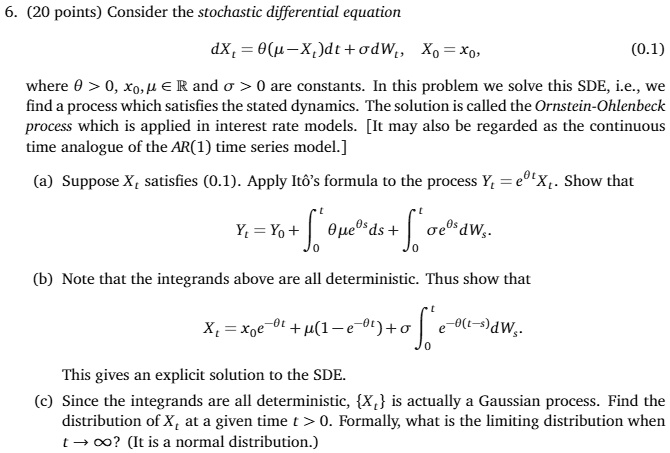
6. (20 points) Consider the stochastic differential equation dX? = ?(? - X?)dt + ?dW?, X? = x?, (0.1) where ? > 0, x?, ? ? ? and ? > 0 are constants. In this problem we solve this SDE, i.e., we find a process which satisfies the stated dynamics. The solution is called the Ornstein-Uhlenbeck process which is applied in interest rate models. [It may also be regarded as the continuous time analogue of the AR(1) time series model.] (a) Suppose X? satisfies (0.1). Apply Itô's formula to the process Y? = e^{?t}X?. Show that Y? = Y? + \int_0^t ??e^{?s}ds + \int_0^t ?e^{?s}dW?. (b) Note that the integrands above are all deterministic. Thus show that X? = x?e^{-?t} + ?(1 - e^{-?t}) + ? \int_0^t e^{-?(t-s)}dW?. This gives an explicit solution to the SDE. (c) Since the integrands are all deterministic, {X?} is actually a Gaussian process. Find the distribution of X? at a given time t > 0. Formally, what is the limiting distribution when t ? ?? (It is a normal distribution.)
View Answer
divider
BEST MATCH

A tank containing 3 kg of CO2 at 200 kPa and 140°C is connected to a second tank containing 2 kg of N2 at 400 kPa and 60°C. A valve is opened and the two tanks are allowed to equalize in pressure. If the final temperature is 50°C, find: a. The heat transfer in kJ b. The final pressure in kPa c. The entropy change in kJ/K

View Answer
divider