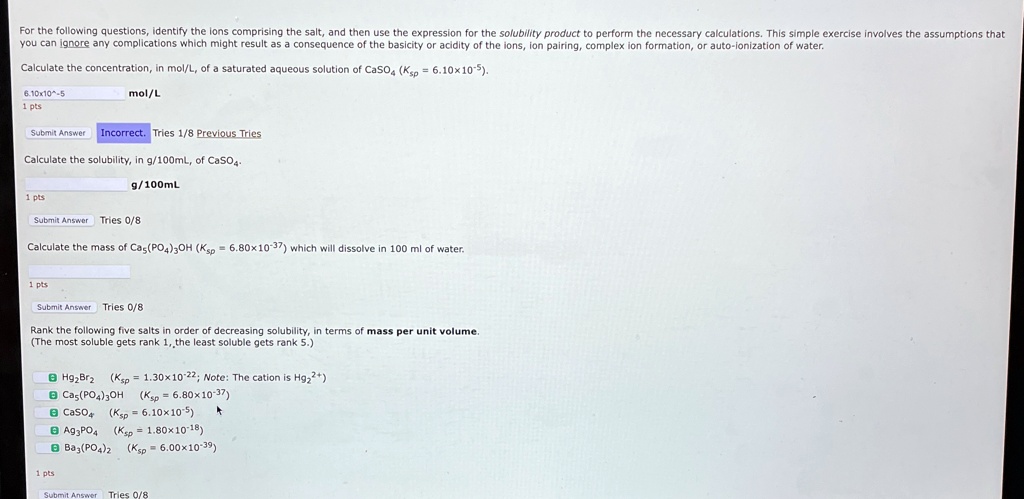
For the following questions, identify the ions comprising the salt, and then use the expression for the solubility product to perform the necessary calculations. This simple exercise involves the assumptions that you can ignore any complications which might result as a consequence of the basicity or acidity of the ions, ion pairing, complex ion formation, or auto-ionization of water.
Calculate the concentration, in mol/L, of a saturated aqueous solution of CaSO$_4$ ($K_{sp} = 6.10 \times 10^{-5}$).
Calculate the solubility, in g/100mL, of CaSO$_4$.
Calculate the mass of Ca$_5$(PO$_4$)$_3$OH ($K_{sp} = 6.80 \times 10^{-37}$) which will dissolve in 100 ml of water.
Rank the following five salts in order of decreasing solubility, in terms of mass per unit volume. (The most soluble gets rank 1, the least soluble gets rank 5.)
Hg$_2$Br$_2$ ($K_{sp} = 1.30 \times 10^{-22}$; Note: The cation is Hg$_2^{2+}$)
Ca$_5$(PO$_4$)$_3$OH ($K_{sp} = 6.80 \times 10^{-37}$)
CaSO$_4$ ($K_{sp} = 6.10 \times 10^{-5}$)
Ag$_3$PO$_4$ ($K_{sp} = 1.80 \times 10^{-18}$)
Ba$_3$(PO$_4$)$_2$ ($K_{sp} = 6.00 \times 10^{-39}$)