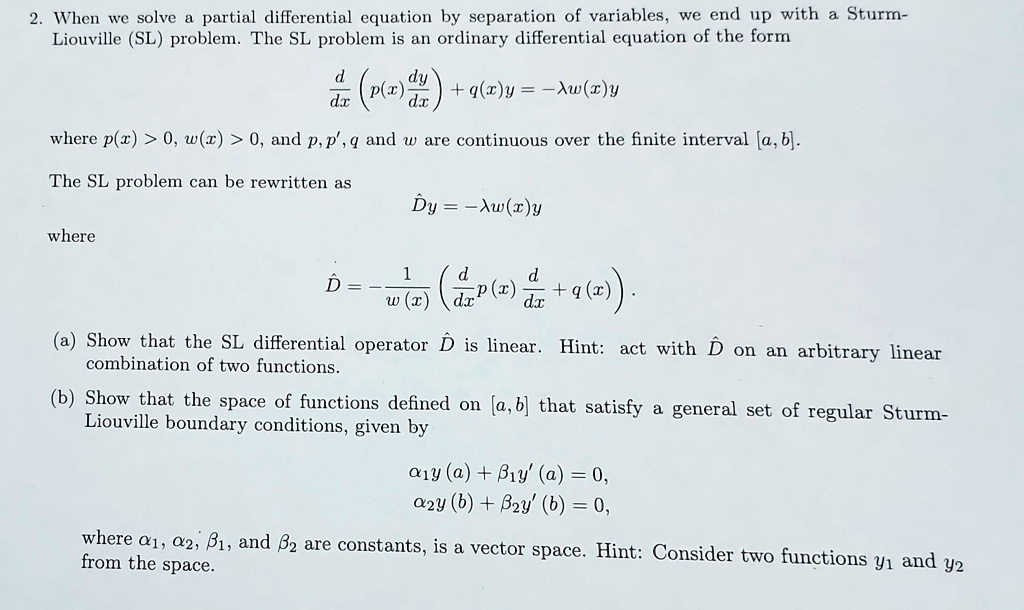
2. When we solve a partial differential equation by separation of variables, we end up with a Sturm-
Liouville (SL) problem. The SL problem is an ordinary differential equation of the form
\frac{d}{dx}\left(p(x)\frac{dy}{dx}\right) + q(x)y = -\lambda w(x)y
where $p(x) > 0$, $w(x) > 0$, and $p$, $p'$, $q$ and $w$ are continuous over the finite interval $[a, b]$.
The SL problem can be rewritten as
$\hat{D}y = -\lambda w(x)y$
where
$\hat{D} = -\frac{1}{w(x)}\left(\frac{d}{dx}p(x)\frac{d}{dx} + q(x)\right)$.
(a) Show that the SL differential operator $\hat{D}$ is linear. Hint: act with $\hat{D}$ on an arbitrary linear
combination of two functions.
(b) Show that the space of functions defined on $[a, b]$ that satisfy a general set of regular Sturm-
Liouville boundary conditions, given by
$\alpha_1 y(a) + \beta_1 y'(a) = 0$,
$\alpha_2 y(b) + \beta_2 y'(b) = 0$,
where $\alpha_1$, $\alpha_2$, $\beta_1$, and $\beta_2$ are constants, is a vector space. Hint: Consider two functions $y_1$ and $y_2$
from the space.