then click in the white box to add it; hydrogens will be added automatically. Use the same settings as
described in the procedure to first perform a geometry optimization, and then perform an electronic
energy calculation. Report the electronic energy below in kJ/mol.
electric
= - 147511.971 kJ/mol
enovy
2. Start a new job in Chem Compute. This time, input two molecules of ammonia: add the first molecule
in the same manner as above, then click the NEW button, and add another N atom a little below the first
molecule. Perform a geometry optimization, then perform an electronic energy calculation. Report the
electronic energy below in kJ/mol.
electronic
= - 293931.223 kg/mol
enovy
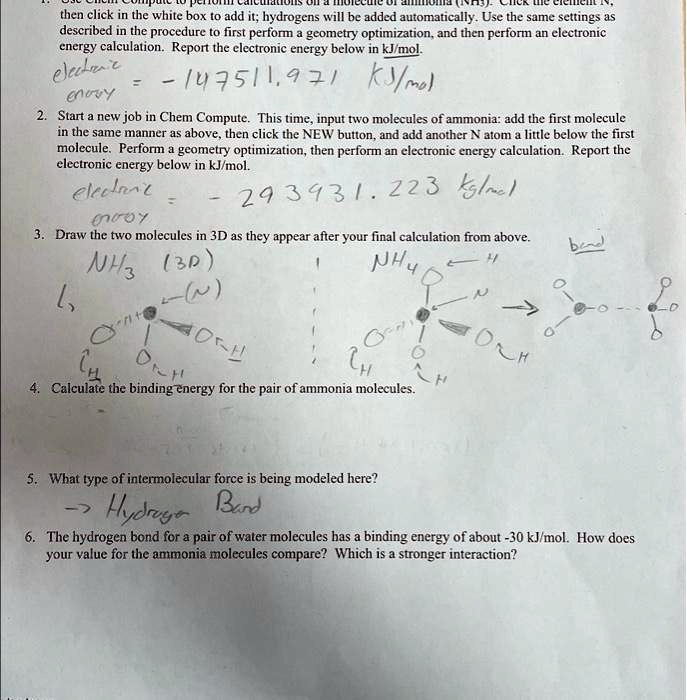
3. Draw the two molecules in 3D as they appear after your final calculation from above.
\(NH_3\) \((3D)\)
\(NH_4\)
4. Calculate the binding energy for the pair of ammonia molecules.
5. What type of intermolecular force is being modeled here?
$\rightarrow$ Hydrogen Bond
6. The hydrogen bond for a pair of water molecules has a binding energy of about -30 kJ/mol. How does
your value for the ammonia molecules compare? Which is a stronger interaction?