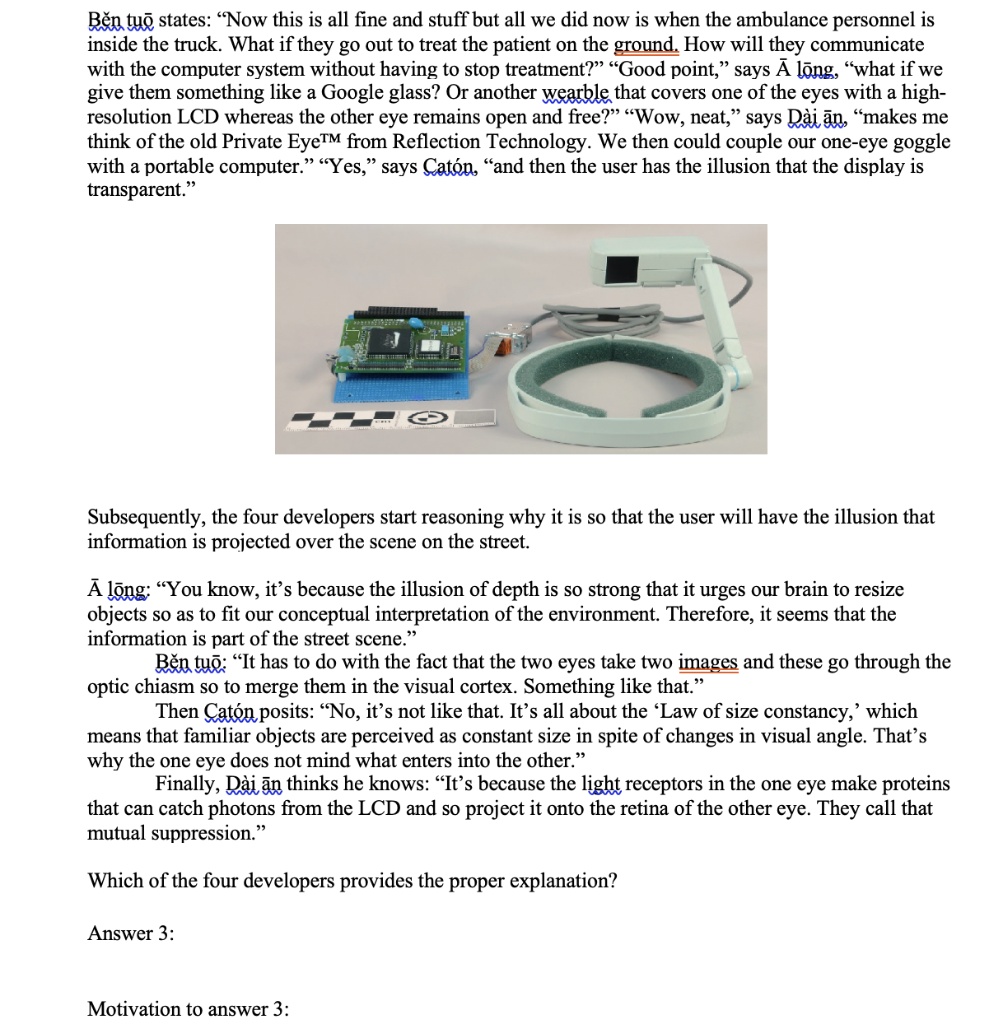
Ben tu& states: "Now this is all fine and stuff, but all we did now is when the ambulance personnel is inside the truck. What if they go out to treat the patient on the ground? How will they communicate with the computer system without having to stop treatment?" "Good point," says A long, "what if we give them something like a Google Glass? Or another wearable that covers one of the eyes with a high-resolution LCD, whereas the other eye remains open and free?" "Wow, neat," says Dai an, "makes me think of the old Private EyeTM from Reflection Technology. We could then couple our one-eye goggle with a portable computer." "Yes," says Caton, "and then the user has the illusion that the display is transparent."
Subsequently, the four developers start reasoning why it is so that the user will have the illusion that information is projected over the scene on the street.
A long: "You know, it's because the illusion of depth is so strong that it urges our brain to resize objects so as to fit our conceptual interpretation of the environment. Therefore, it seems that the information is part of the street scene."
Ben tu: "It has to do with the fact that the two eyes take two images and these go through the optic chiasm to merge them in the visual cortex. Something like that."
Then Caton posits: "No, it's not like that. It's all about the 'Law of size constancy,' which means that familiar objects are perceived as a constant size in spite of changes in visual angle. That's why the one eye does not mind what enters into the other."
Finally, Dai an thinks he knows: "It's because the light receptors in the one eye make proteins that can catch photons from the LCD and so project it onto the retina of the other eye. They call that mutual suppression.