Ace - AI Tutor
Ask Our Educators
Textbooks
My Library
Flashcards
Scribe - AI Notes
Notes & Exams
Download App
sherry lyons

sherry l.

Divider

Questions asked

BEST MATCH

Date For the following flow field find i The Stagnation Points if any. ii The acceleration Vector. iii The Stream function. iv Plot three representative Streamlines and show the directions. ① $\vec{V} = 2\hat{i} - \hat{j}$ ② $\vec{V} = 3\hat{i} + x\hat{j}$ ③ $\vec{V} = x\hat{i} - y\hat{j}$ ④ $\vec{V} = 2\hat{i} + 3\hat{j}$ ⑤ $\vec{V} = x\hat{i} - \frac{y^2}{2}\hat{j}$ ⑥ $\vec{V} = (y-3)\hat{i} + 1\hat{j}$ ⑦ $\vec{V} = \hat{i}$

View Answer
divider
BEST MATCH

In a Poisson distribution $\mu = 4.90$. Required: Note: Round your answers to 4 decimal places. a. What is the probability that $x = 0$? Probability Answer is complete and correct. 0.0075 b. What is the probability that $x > 2$? Answer is complete but not entirely correct. Probability 0.8667

View Answer
divider
BEST MATCH

Under absorption costing, fixed manufacturing overhead: Question 13Select one: a. Follows both the period and the product b. Follows the period c. Follows the product d. Follows neither the period nor the product

View Answer
divider
BEST MATCH

A thick oak wall initially at 25°C is suddenly exposed to gases for which $T_\infty$ = 800°C and $h$ = 20 W/m$^2$-K. Answer the following questions. Note: Evaluate the properties of the wall as cross grain oak at 300 K. What is the surface temperature, in °C, after 275 s? $T(0, 275 \text{ sec}) = $ °C Will the surface of the wall reach the ignition temperature of oak (400°C) after 275 s? What is the temperature, in °C, 1 mm from the surface after 275 s? $T(1 \text{ mm}, 275 \text{ sec}) = $ °C

View Answer
divider
BEST MATCH

Assume the reserve ratio is 15 percent and central bank buy $3 million of government securities from the public, which deposits this amount into checking accounts. As a result of these transactions, the supply of money is: O a. directly increased by $3 million and the money-creating potential of the commercial banking system is increased by an additional $18 million. O b. directly reduced by $3 million and the money-creating potential of the commercial banking system is decreased by an additional $20 million. O c. not directly affected, but the money-creating potential of the commercial banking system is increased by $20 million. O d. directly increased by $3 million and the money-creating potential of the commercial banking system is increased by an additional $17 million.

View Answer
divider
BEST MATCH

Suppose that researchers discover that coffee is a leading cause of cancer. Does this finding cause a movement or shift along the original demand curve for coffee beans? ? Choose... Both will increase There will be a shift in the demand curve to the left. There will be a shift in the demand curve to the right. Equilibrium price will increase but quantity bought and sold will decrease. Both will decrease There will be downward movement along the same demand curve. What will happen to the equilibrium Choose... price and quantity of coffee beans?

View Answer
divider
BEST MATCH

Q8. Find $v_1(t)$, $i_1(t)$, and $i_2(t)$. Evaluate $v_1(t)$, $i_1(t)$, and $i_2(t)$ at $t = 1.2$ ms.

View Answer
divider
BEST MATCH

13. $f(\theta) = \frac{\sin \theta}{1 + \cos \theta}$ 14. $y = \frac{\cos x}{1 - \sin x}$ 15. $y = \frac{x}{2 - \tan x}$ 16. $f(t) = \frac{\cot t}{e^t}$ 17. $f(w) = \frac{1 + \sec w}{1 - \sec w}$ 18. $y = \frac{\sin t}{1 + \tan t}$ 19. $y = \frac{t \sin t}{1 + t}$ 20. $g(z) = \frac{z}{\sec z + \tan z}$ 21. $f(\theta) = \theta \cos \theta \sin \theta$ 22. $f(t) = te^t \cot t$

View Answer
divider
BEST MATCH

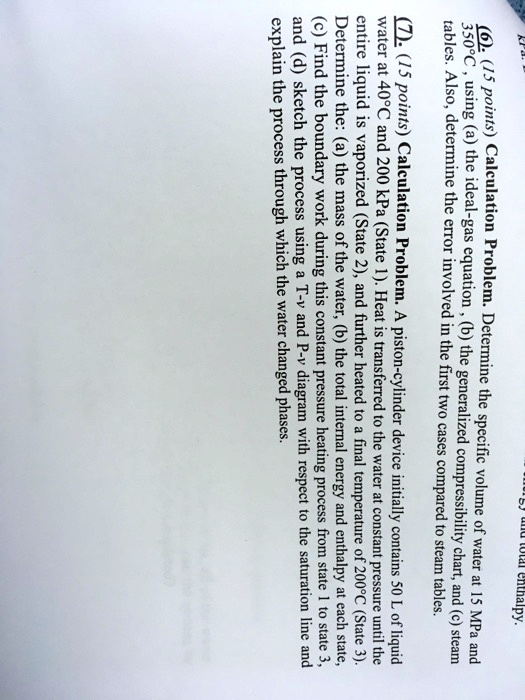
(6). (15 points) Calculation Problem. Determine the specific volume of water at 15 MPa and 350°C, using (a) the ideal-gas equation, (b) the generalized compressibility chart, and (c) steam tables. Also, determine the error involved in the first two cases compared to steam tables. (7). (15 points) Calculation Problem. A piston-cylinder device initially contains 50 L of liquid water at 40°C and 200 kPa (State 1). Heat is transferred to the water at constant pressure until the entire liquid is vaporized (State 2), and further heated to a final temperature of 200°C (State 3). Determine the: (a) the mass of the water, (b) the total internal energy and enthalpy at each state, (c) Find the boundary work during this constant pressure heating process from state 1 to state 3, and (d) sketch the process using a T-v and P-v diagram with respect to the saturation line and explain the process through which the water changed phases.
View Answer
divider
BEST MATCH

The following lead compensator is designed to obtain the desired closed-loop pole at (-2 + j2). Determine the gain $K_c$ of the compensator. Select one: a. 4 b. 1 c. 2 d. 6

View Answer
divider