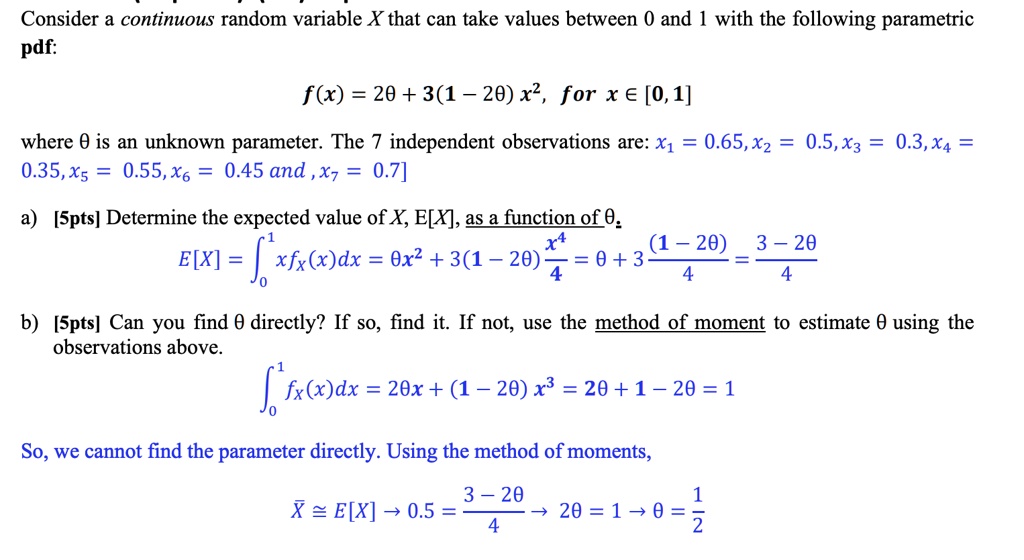
Consider a continuous random variable $X$ that can take values between 0 and 1 with the following parametric
pdf:
$f(x) = 2\theta + 3(1 - 2\theta)x^2$, for $x \in [0, 1]$
where $\theta$ is an unknown parameter. The 7 independent observations are: $x_1 = 0.65, x_2 = 0.5, x_3 = 0.3, x_4 =$
$0.35, x_5 = 0.55, x_6 = 0.45$ and, $x_7 = 0.7$
a) [5pts] Determine the expected value of X, E[X], as a function of $\theta$.
$E[X] = \int_0^1 xf_x(x)dx = 0x^2 + 3(1 - 2\theta)\frac{x^4}{4} = 0 + 3\frac{(1 - 2\theta)}{4} = \frac{3 - 2\theta}{4}$
b) [5pts] Can you find $\theta$ directly? If so, find it. If not, use the method of moment to estimate $\theta$ using the
observations above.
$\int_0^1 f_x(x)dx = 2\theta x + (1 - 2\theta)x^3 = 2\theta + 1 - 2\theta = 1$
So, we cannot find the parameter directly. Using the method of moments,
$\bar{X} \approx E[X] \to 0.5 = \frac{3 - 2\theta}{4} \to 2\theta = 1 \to \theta = \frac{1}{2}$