Ace - AI Tutor
Ask Our Educators
Textbooks
My Library
Flashcards
Scribe - AI Notes
Notes & Exams
Download App
sheryl payne

sheryl p.

Divider

Questions asked

BEST MATCH

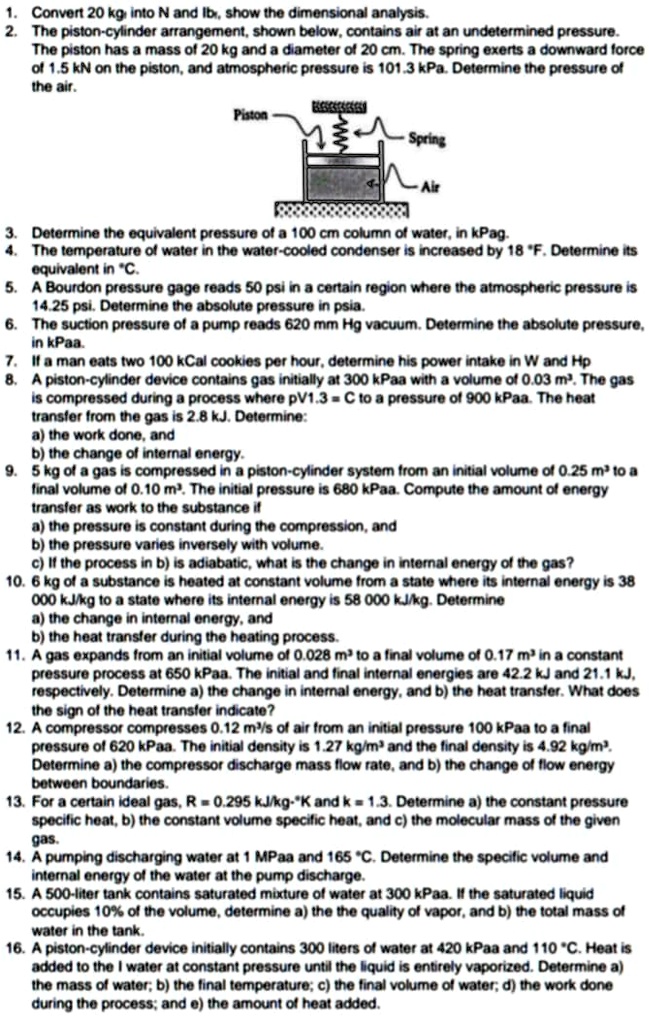
1. Convert 20 kg into N and lb, show the dimensional analysis. 2. The piston-cylinder arrangement, shown below, contains air at an undetermined pressure. The piston has a mass of 20 kg and a diameter of 20 cm. The spring exerts a downward force of 1.5 kN on the piston, and atmospheric pressure is 101.3 kPa. Determine the pressure of the air. 3. Determine the equivalent pressure of a 100 cm column of water, in kPag. 4. The temperature of water in the water-cooled condenser is increased by 18 °F. Determine its equivalent in °C. 5. A Bourdon pressure gage reads 50 psi in a certain region where the atmospheric pressure is 14.25 psi. Determine the absolute pressure in psia. 6. The suction pressure of a pump reads 620 mm Hg vacuum. Determine the absolute pressure, in kPaa. 7. If a man eats two 100 kCal cookies per hour, determine his power intake in W and Hp. 8. A piston-cylinder device contains gas initially at 300 kPaa with a volume of 0.03 m³. The gas is compressed during a process where $pV^{1.3} = C$ to a pressure of 900 kPaa. The heat transfer from the gas is 2.8 kJ. Determine: a) the work done, and b) the change of internal energy. 9. 5 kg of a gas is compressed in a piston-cylinder system from an initial volume of 0.25 m³ to a final volume of 0.10 m³. The initial pressure is 680 kPaa. Compute the amount of energy transfer as work to the substance if a) the pressure is constant during the compression, and b) the pressure varies inversely with volume. c) If the process in b) is adiabatic, what is the change in internal energy of the gas? 10. 6 kg of a substance is heated at constant volume from a state where its internal energy is 38 000 kJ/kg to a state where its internal energy is 58 000 kJ/kg. Determine a) the change in internal energy, and b) the heat transfer during the heating process. 11. A gas expands from an initial volume of 0.028 m³ to a final volume of 0.17 m³ in a constant pressure process at 650 kPaa. The initial and final internal energies are 42.2 kJ and 21.1 kJ, respectively. Determine a) the change in internal energy, and b) the heat transfer. What does the sign of the heat transfer indicate? 12. A compressor compresses 0.12 m³/s of air from an initial pressure 100 kPaa to a final pressure of 620 kPaa. The initial density is 1.27 kg/m³ and the final density is 4.92 kg/m³. Determine a) the compressor discharge mass flow rate, and b) the change of flow energy between boundaries. 13. For a certain ideal gas, $R = 0.295 kJ/kg \cdot K$ and $k = 1.3$. Determine a) the constant pressure specific heat, b) the constant volume specific heat, and c) the molecular mass of the given gas. 14. A pumping discharging water at 1 MPa and 165 °C. Determine the specific volume and internal energy of the water at the pump discharge. 15. A 500-liter tank contains saturated mixture of water at 300 kPaa. If the saturated liquid occupies 10% of the volume, determine a) the quality of vapor, and b) the total mass of water in the tank. 16. A piston-cylinder device initially contains 300 liters of water at 420 kPaa and 110 °C. Heat is added to the water at constant pressure until the liquid is entirely vaporized. Determine a) the mass of water; b) the final temperature; c) the final volume of water; d) the work done during the process; and e) the amount of heat added.
View Answer
divider
BEST MATCH

Find the domain of the function. (Enter your answer 1 h(x) = \frac{4}{\sqrt{x^2 - 9x}} ( - \infty,0) \cup (0,9) \cup (9,\infty)

View Answer
divider
BEST MATCH

Units Marginal cost ($/unit) Units Marginal cost ($/unit) 0 3.25 7000 2.19 1000 2.88 8000 2.18 2000 2.78 9000 2.20 3000 2.75 10,000 2.24 4000 2.56 11,000 2.38 5000 2.40 12,000 2.62 6000 2.27 13,000 2.82 (a) Estimate the cost (not including fixed costs) to produce the first 12,000 units by considering batches of 2000 units. Use the initial marginal cost for each batch in your calculations. $

View Answer
divider
BEST MATCH

Q1.1 Which belongs to Kingdom Chromista? 2 Points Oysters Bacteria Forams Crabs Sargassum Q1.2 Which belongs to Kingdom Protista? 2 Points Bacteria Crabs Oysters Sargassum Forams Q1.3 Which is a filter feeder? 2 Points Crabs Oysters Bacteria Sargassum Q1.1 Which belongs to Kingdom Chromista? 2 Points O Oysters O Bacteria O Forams O Crabs O Sargassum Q1.2 Which belongs to Kingdom Protista? 2Points O Bacteria O crabs O Oysters O Sargassum O Forams Q1.3 Which is a filter feeder? 2 Points O Crabs O Oysters O Bacteria O Sargassum

View Answer
divider
BEST MATCH

Find the first-quadrant area bounded by $y = \frac{1}{x^3 + 4x^2 + 3x}$, $x = 1$, and $x = 3$. Select one: a. $\frac{1}{6} \ln \frac{27}{16}$ b. $\frac{1}{3} \ln \frac{1}{2}$ c. $\frac{1}{6} \ln \frac{2}{27}$ d. $6 \ln \frac{2}{27}$ e. $6 \ln \frac{1}{27}$

View Answer
divider
BEST MATCH

2. You are on the planet Gliese 357 d (GJ 357 d) $2.9 \times 10^{14}$ m away from Earth in a planetary system orbiting the star Gliese 357 [depicted above], and you have determined with the help of your orbiting satellite that the central star is 30,000,000,000 m from the GJ 357 d. You observe the brightest planet (GJ 357 c) in the sky to reach a greatest elongation angle of $17^\circ$ from the central star. What is the distance of that planet from the one you are standing on? Draw the diagram of GJ 357 d, Gliese 357, & GJ 357 c, label the distances, and solve using mathematical symbols $d_d$ as the distance of GJ 357 d from Gliese 357, $d_c$ as the distance of GJ 357 c from Gliese 357, and $\theta$ as the greatest elongation angle before using a calculator to get $d_c$ in m.

View Answer
divider
BEST MATCH

QUESTION 3 In the question below, assume that a firm has the following costs (q = output): Total Costs Total Costs Marginal Cost TC = 200 TC = 500 + 5q + 2q^2 MC = 5 \times 4q What would be the value of this firm's average variable cost if the firm is producing 10 units? O a. $250 O b. $75 O c. $25 O d. none of the above if q = 0 if q > 0 if q > 0

View Answer
divider
BEST MATCH

A 4 k\Omega resistor is placed in parallel with the current source in the circuit shown in (Figure 1). Assume you have been asked to calculate the power developed by the current source when current $i$ is known. Figure 1 of 1 Correct Here we learn how to choose a more efficient method of circuit analysis to solve a circuit for the desired quantity. Part B Find the power developed by the current source if $i = 11 mA$. Express your answer to three significant figures and include the appropriate units. View Available Hint(s) $P_{dev} = $ Value Units Submit

View Answer
divider
BEST MATCH

3. $2\frac{1}{2} \times x \frac{3}{8} = -\frac{3}{2} x \frac{3}{8} = -\frac{3}{16}$

View Answer
divider
BEST MATCH

A. Describe the transformation performed on each function g(x) to result in d(x). 1. g(x) = x^2 d(x) = x^2 - 5 2. g(x) = x^2 d(x) = -x^2

View Answer
divider