Ace - AI Tutor
Ask Our Educators
Textbooks
My Library
Flashcards
Scribe - AI Notes
Notes & Exams
Download App
Smith Trent

Smith T.

Divider

Viewed Questions

A 7.50-nF capacitor is charged up to 12.0 V, then disconnected from the power supply and connected in series through a coil. The period of oscillation of the circuit is then measured to be 8.60 $\times$ 10$^{-5}$ s. Calculate: (a) the inductance of the coil; (b) the maximum charge on the capacitor; (c) the total energy of the circuit; (d) the maximum current in the circuit.

A 7.50-nF capacitor is charged up to 12.0 V, then disconnected from the power supply and connected in series through a coil. The period of oscillation of the circuit is then measured to be 8.60 $\times$ 10$^{-5}$ s. Calculate: (a) the inductance of the coil; (b) the maximum charge on the capacitor; (c) the total energy of the circuit; (d) the maximum current in the circuit.

University Physics with Modern Physics

Inductance

The L-C Circuit

The gravitational force between two point masses separated by a distance $r$ is proportional to $1 / r^{2},$ just like the electric force between two point charges. Because of this similarity between gravitational and electric interactions, there is also a Gauss's law for gravitation. (a) Let $\vec{g}$ be the acceleration due to gravity caused by a point mass $m$ at the origin, so that $\vec{g}=-\left(G m / r^{2}\right) \hat{r}$ . Consider a spherical Gaussian surface with radius $r$ centered on this point mass, and show that the flux of $\vec{g}$ through this surface is given by $$\oint \vec{g} \cdot d \vec{A}=-4 \pi G m$$ (b) By following the same logical steps used in Section 22.3 to obtain Gauss's law for the electric field, show that the flux of $\vec{g}$ through any closed surface is given by
$$\oint \vec{g} \cdot d \vec{A}=-4 \pi G M_{\mathrm{encl}}$$ where $M_{\text { encl }}$ is the total mass enclosed within the closed surface.

The gravitational force between two point masses separated by a distance $r$ is proportional to $1 / r^{2},$ just like the electric force between two point charges. Because of this similarity between gravitational and electric interactions, there is also a Gauss's law for gravitation. (a) Let $\vec{g}$ be the acceleration due to gravity caused by a point mass $m$ at the origin, so that $\vec{g}=-\left(G m / r^{2}\right) \hat{r}$ . Consider a spherical Gaussian surface with radius $r$ centered on this point mass, and show that the flux of $\vec{g}$ through this surface is given by $$\oint \vec{g} \cdot d \vec{A}=-4 \pi G m$$ (b) By following the same logical steps used in Section 22.3 to obtain Gauss's law for the electric field, show that the flux of $\vec{g}$ through any closed surface is given by $$\oint \vec{g} \cdot d \vec{A}=-4 \pi G M_{\mathrm{encl}}$$ where $M_{\text { encl }}$ is the total mass enclosed within the closed surface.

University Physics with Modern Physics

The gravitational force between two point masses separated by a distance $r$ is proportional to $1 / r^{2}$, just like the electric force between two point charges. Because of this similarity between gravitational and electric interactions, there is also a Gauss's law for gravitation. (a) Let $\vec{g}$ be the acceleration due to gravity caused by a point mass $m$ at the origin, so that $\vec{g}=-\left(G m / r^{2}\right) \hat{r}$. Consider a spherical Gaussian surface with radius $r$ centered on this point mass, and show that the flux of $\vec{g}$ through this surface is given by $$ \oint \vec{g} \cdot d \overrightarrow{\boldsymbol{A}}=-4 \pi G m $$ (b) By following the same logical steps used in Section $22.3$ to obtain Gauss's law for the electric field, show that the flux of $\vec{g}$ through any closed surface is given by $$ \oint \vec{g} \cdot d \vec{A}=-4 \pi G M_{\text {encl }} $$ where $M_{\text {encl }}$ is the total mass enclosed within the closed surface.

University Physics with Modern Physics

22.65. Electric Field Inside a Hydrogen Atom. A hydrogen atom is made up of a proton of charge $+Q=1.60 \times 10^{-19} \mathrm{C}$ and an electron of charge $-Q=-1.60 \times 10^{-19} \mathrm{C}$ . The proton may be regarded as a point charge at $r=0$ , the center of the atom. The motion of the electron causes its charge to be "smeared out" into a spherical distribution around the proton, so that the electron is equivalent to a charge per unit volume of
$$
\rho(r)=-\frac{Q}{\pi a_{0}^{3}} e^{-2 r / a_{0}}
$$

22.65. Electric Field Inside a Hydrogen Atom. A hydrogen atom is made up of a proton of charge $+Q=1.60 \times 10^{-19} \mathrm{C}$ and an electron of charge $-Q=-1.60 \times 10^{-19} \mathrm{C}$ . The proton may be regarded as a point charge at $r=0$ , the center of the atom. The motion of the electron causes its charge to be "smeared out" into a spherical distribution around the proton, so that the electron is equivalent to a charge per unit volume of $$ \rho(r)=-\frac{Q}{\pi a_{0}^{3}} e^{-2 r / a_{0}} $$

University Physics with Modern Physics

Questions asked

INSTANT ANSWER

\( \mathrm{D} \) Consider the set of all real polynomials of degree at most two, \( \mathbb{P}_{2}=\left\{a_{2} x^{2}+a_{1} x+a_{0} \mid a_{2}, a_{1}, a_{0}, x \in \mathbb{R}\right\} \), which is a vector space over a field \( \mathbb{R} \). Then, check whether the subset \( S=\left\{x^{2}-3 x, 2 x+1\right\} \) of \( \mathbb{P}_{2} \) spans \( \mathbb{P}_{2} \). ( 7 points)

View Answer
divider
ANSWERED

Ankur S verified

Numerade educator

Coaxial Cable A has twice the length, twice the radius of the inner solid conductor, and twice the radius of the outer cylindrical conducting shell of coaxial Cable B. Find the ratio of the inductance of Cable A to that of Cable B.

View Answer
divider
ANSWERED

Penny Riley verified

Numerade educator

In the practice 1.3, we obtain the self inductance of a toroidal solenoid expressed by L = ??(N²A/2?r'), when the magnetic field is uniform across the cross section of the toroidal solenoid. But the magnetic field is not uniform because the magnetic field depends on the distance from the center given by B = ??(Ni/2?r). We consider a certain toroidal solenoid with a rectangular cross section as shown in the figure. Show that the inductance of the toroidal solenoid is given by L = ??(N²h/2?)ln(b/a).

View Answer
divider
ANSWERED

Penny Riley verified

Numerade educator

Two toroidal solenoids are wound around the same form so that the magnetic field of one passes through the turns of the other. Solenoid 1 has 500 turns, while solenoid 2 has 300 turns. When the current in solenoid 1 is 3.21A, the average flux through each turn of solenoid 2 is 0.0120Wb. When the current in solenoid 2 is 1.23A, find the average flux through each turn of solenoid 1.

View Answer
divider
ANSWERED

Jacob Fry verified

Numerade educator

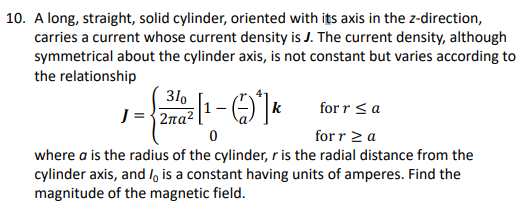
10. A long, straight, solid cylinder, oriented with its axis in the z-direction, carries a current whose current density is ( oldsymbol{J} ). The current density, although symmetrical about the cylinder axis, is not constant but varies according to the relationship [ J=left{egin{array}{cc} frac{3 I_{0}}{2 pi a^{2}}left[1-left(frac{r}{a} ight)^{4} ight] oldsymbol{k} & ext { for } r leq a \ 0 & ext { for } r geq a end{array} ight. ] where ( a ) is the radius of the cylinder, ( r ) is the radial distance from the cylinder axis, and ( I_{0} ) is a constant having units of amperes. Find the magnitude of the magnetic field.
View Answer
divider
ANSWERED

Brian Francisco verified

Numerade educator

A long hollow cylindrical conductor (inner radius = 3.0mm, outer radius = 5.0mm) carries a current of 1.0A distributed uniformly across its cross section. A long wire which is coaxial with the cylinder carries an equal current in the opposite direction. Find the magnitude of the magnetic field 4.0mm from the axis.

View Answer
divider
ANSWERED

Timothy James verified

Numerade educator

A long cylindrical wire (radius = 5.0 cm) carries a current of 2.0 A that is uniformly distributed over a cross section of the wire. Calculate the magnitude of the magnetic field at a point which is 3.0 cm from the axis of the wire.

View Answer
divider
ANSWERED

Cal Wilkens verified

Numerade educator

10. A rectangular loop of copper wire is in a uniform magnetic and gravitational fields. Both fields are parallel to ( y )-axis as shown in the figure. The loop has a mass of ( 0.28 mathrm{~g} ) per centimeter of length and is pivoted about side ( a b ) on a frictionless axis. The current in the wire is ( 2.0 mathrm{~A} ) in the direction shown. Find the magnetic field that will cause the loop to swing up until its plane makes an angle of 20 degree with the ( y z )-plane.

View Answer
divider
ANSWERED

Ankur S verified

Numerade educator

A current of 1.0 A is maintained in a single circular loop having a circumference of 1.0m. An external magnetic field of 2.0T is directed so that the angle between the field and the plane of the loop is 60°. Calculate the magnitude of the torque exerted on the loop by the magnetic forces acting upon it.

View Answer
divider
ANSWERED

Ankur S verified

Numerade educator

A straight wire carries a current of 2.0 A in a uniform magnetic field (magnitude = 5.0 T). If the force per unit length on this wire is 2.0 N/m, determine the angle between the wire and the magnetic field

View Answer
divider