\( \operatorname{die} A \)
\[
\begin{array}{l}
\text { probability } \\
\text { of outcome }
\end{array}
\]
1/9
\( 1 / 9 \)
\( 1 / 9 \)
\( 1 / 9 \)
\( 1 / 9 \)
\( 1 / 9 \)
\( 1 / 9 \)
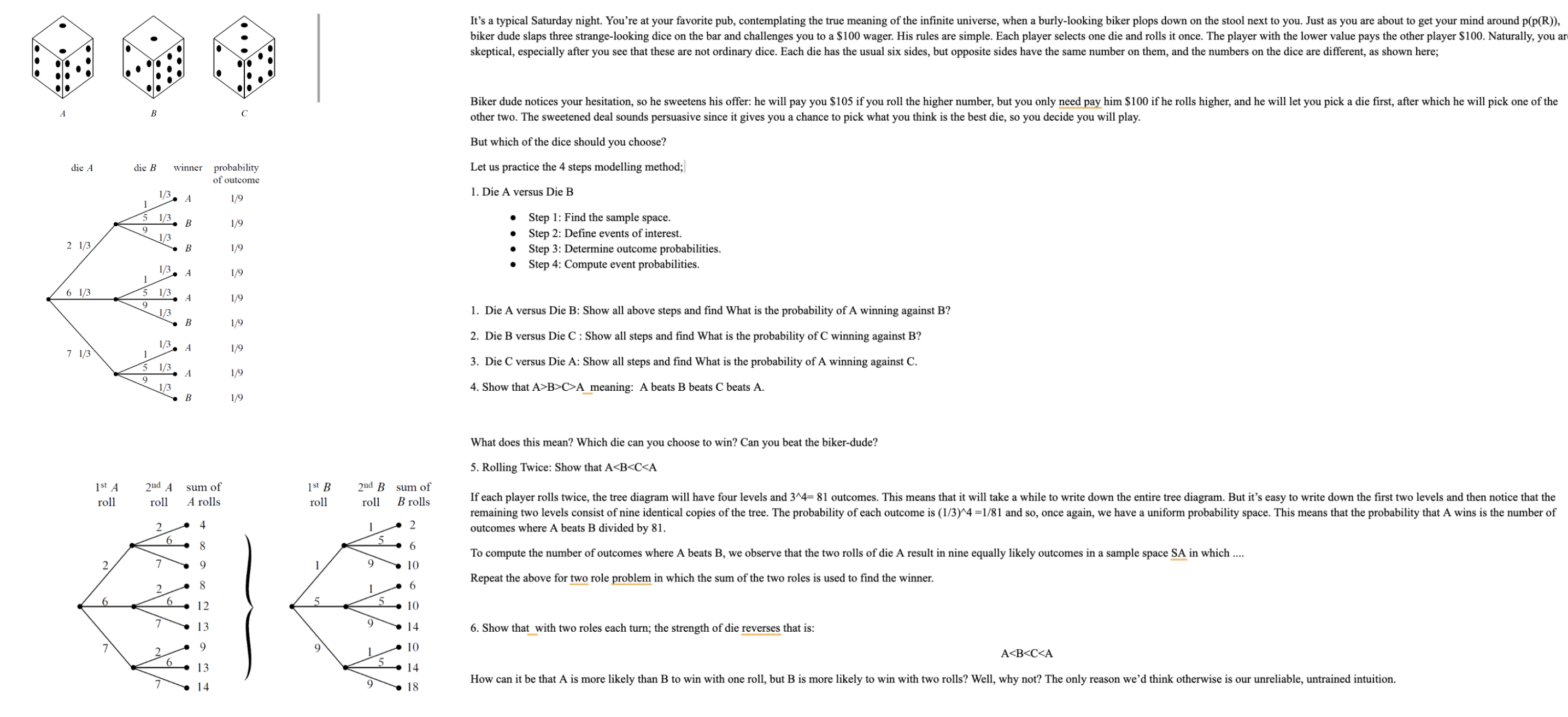
\( 1^{\text {st }} A \quad 2^{\text {nd }} A \quad \) sum of roll roll \( A \) rolls skeptical, especially after you see that these are not ordinary dice. Each die has the usual six sides, but opposite sides have the same number on them, and the numbers on the dice are different, as shown here; other two. The sweetened deal sounds persuasive since it gives you a chance to pick what you think is the best die, so you decide you will play.
But which of the dice should you choose?
Let us practice the 4 steps modelling method;
1. Die A versus Die B
- Step 1: Find the sample space.
- Step 2: Define events of interest.
- Step 3: Determine outcome probabilities.
- Step 4: Compute event probabilities.
1. Die A versus Die B: Show all above steps and find What is the probability of A winning against B?
2. Die \( \mathrm{B} \) versus Die \( \mathrm{C} \) : Show all steps and find What is the probability of \( \mathrm{C} \) winning against \( \mathrm{B} \) ?
3. Die C versus Die A: Show all steps and find What is the probability of A winning against C.
4. Show that \( \mathrm{A}>\mathrm{B}>\mathrm{C}>\mathrm{A} \) meaning: \( \mathrm{A} \) beats \( \mathrm{B} \) beats \( \mathrm{C} \) beats \( \mathrm{A} \).
What does this mean? Which die can you choose to win? Can you beat the biker-dude?
5. Rolling Twice: Show that \( \mathrm{A}<\mathrm{B}<\mathrm{C}<\mathrm{A} \) outcomes where A beats B divided by 81 .
To compute the number of outcomes where A beats B, we observe that the two rolls of die A result in nine equally likely outcomes in a sample space SA in which ....
Repeat the above for two role problem in which the sum of the two roles is used to find the winner.
6. Show that with two roles each turn; the strength of die reverses that is:
\( \mathrm{A}<\mathrm{B}<\mathrm{C}<\mathrm{A} \)