Ace - AI Tutor
Ask Our Educators
Textbooks
My Library
Flashcards
Scribe - AI Notes
Notes & Exams
Download App
Circe  Alex

Circe A.

Divider

Viewed Questions

Use spherical coordinates.

Find the mass and center of mass of a solid hemisphere of radius $ a $ if the density at any point is proportional to its distance from the base.

Use spherical coordinates. Find the mass and center of mass of a solid hemisphere of radius $ a $ if the density at any point is proportional to its distance from the base.

Calculus: Early Transcendentals

Multiple Integrals

Triple Integrals in Spherical…

A spherical solid has radius $a$, and the density al any point is directly proportional to its distance from the center of the sphere. Use spherical coordinates to find the mass.

Calculus

Multiple Integrals

Review Exercises

Center of Mass Find the center of mass of the upper half of the sphere $x^{2}+y^{2}+z^{2}=a^{2}$ covered by a thin material with mass density at each point proportional to the distance from the $x y$ -plane.

Calculus, Early Transcendentals

Vector Calculus

Surface and Flux Integrals

Questions asked

INSTANT ANSWER

Q6 (a) A spherical ball of radius 1 , centred at the origin, is filled with fluid that has a density that varies with height \( z \) as \( \rho=1+b z+a z^{2} \), where \( a \) and \( b \) are positive constants. Determine (i) the total mass. (ii) the centre of mass. (b) A complex function is given by \( f(x, y)=U+i V \) where \( U=x^{3}-3 y^{2} x \) and \( V=3 y x^{2}-y^{3} \). Determine if the function is analytic or not.

View Answer
divider
ANSWERED

Dan Quijada verified

Numerade educator

An examiner is trying to write a question all about surfaces and critical points, based on a hillside that has a functional form f(x, y) = y^4 + x^4 - 2x^2 - 2y^2 - ax^2y^2 where a is some non-negative constant. The idea is that the function should have stable minima, and the students would be asked to find them and all the other critical points. However the examiner finds that not all values of a work. If a is too big for example there are no minima. What values of a would give good minima? Find all the critical points in terms of a and determine what kind they are. [Hint: you should find that there can be 9 critical points in total.]

View Answer
divider
ANSWERED

Zhaojie Xu verified

Numerade educator

Q4 (a) A function ( f(x) ) is periodic with period ( 2 pi ) and is defined in the interval ( -pi leq ) ( x leq pi ) to be ( f(x)=x^{2} ). Find the Fourier series for ( f(x) ), and use your result and Parseval's Theorem to evaluate the sum [ S=sum_{n=1}^{infty} frac{1}{n^{4}} ] (b) Find the general solution to the PDE [ u_{x x}+y^{2} u=0, ] and find the particular solution that satisfies the boundary conditions [ egin{aligned} u(0, y) &=y^{2} \ u_{x}(0, y) &=y^{2} end{aligned} ]

View Answer
divider
ANSWERED

Andrew Sullivan verified

Numerade educator

Q3 A forced damped simple harmonic oscillator obeys the equation [ ddot{x}+2 dot{x}+left(n^{2}+1 ight) x=sin (n t) ] where ( n ) is a positive constant. If ( x(0)=dot{x}(0)=0 ) find ( x(t) ). Show that in the limit of large ( t, x(t) ) settles down to an oscillation of amplitude ( X ), where [ X=frac{1}{sqrt{4 n^{2}+1}} ] You may assume that ( alpha cos (kappa t)+eta sin (kappa t) ) is an oscillation of amplitude ( sqrt{alpha^{2}+eta^{2}} ).

View Answer
divider
INSTANT ANSWER

Q2 (a) The population \( P(t) \) of bacteria obeys the differential equation \[ \frac{d P}{d t}=-2 P+100 t \text {. } \] If at \( t=0 \) the population is \( P(0)=200 \), calculate the population \( P(t) \) at later times, and use your result to find an expression for the minimum population at later times. (b) The functions \( u(x) \) and \( v(x) \) satisfy the coupled first order differential equations \[ \begin{array}{l} u^{\prime}=u+4 v+4 e^{-x} \\ v^{\prime}=2 u-v+e^{x} \end{array} \] Find \( u(x) \) and \( v(x) \) if \( u(0)=4 \) and \( v(0)=-1 \).

View Answer
divider
INSTANT ANSWER

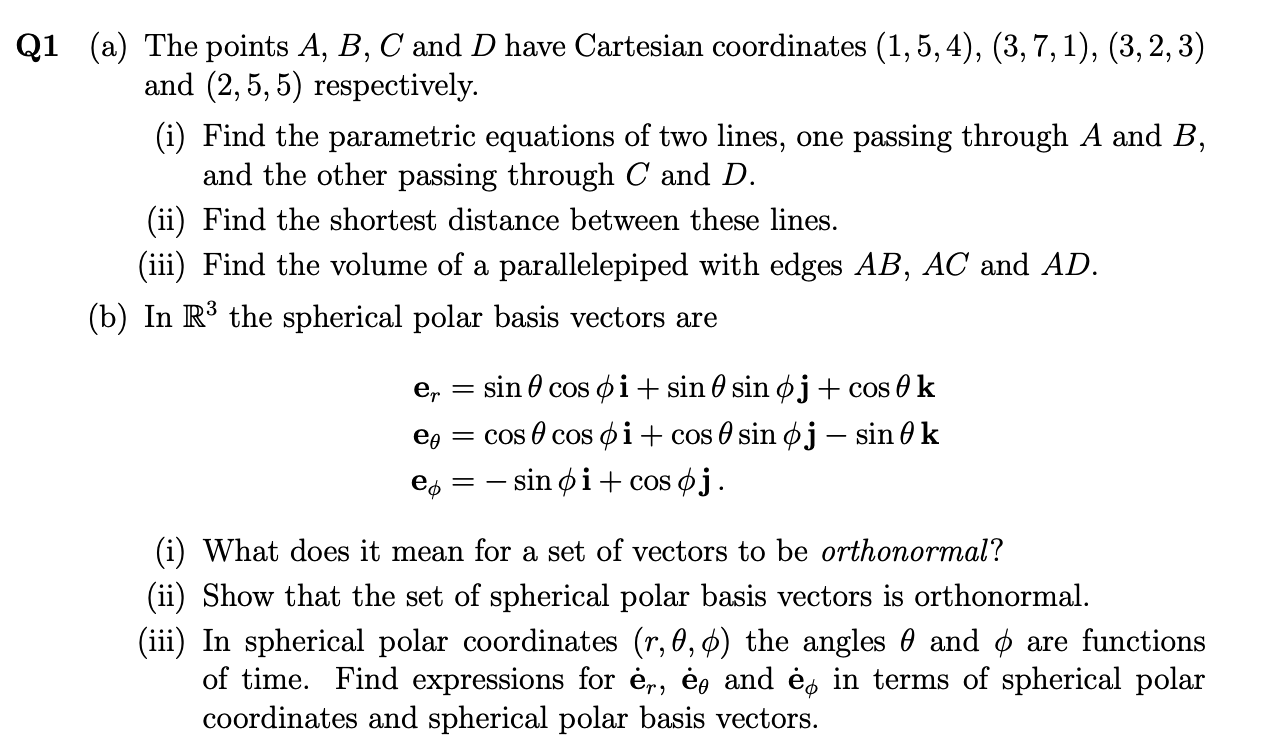
Q1 (a) The points \( A, B, C \) and \( D \) have Cartesian coordinates \( (1,5,4),(3,7,1),(3,2,3) \) and \( (2,5,5) \) respectively. (i) Find the parametric equations of two lines, one passing through \( A \) and \( B \), and the other passing through \( C \) and \( D \). (ii) Find the shortest distance between these lines. (iii) Find the volume of a parallelepiped with edges \( A B, A C \) and \( A D \). (b) In \( \mathbb{R}^{3} \) the spherical polar basis vectors are \[ \begin{array}{l} \mathbf{e}_{r}=\sin \theta \cos \phi \mathbf{i}+\sin \theta \sin \phi \mathbf{j}+\cos \theta \mathbf{k} \\ \mathbf{e}_{\theta}=\cos \theta \cos \phi \mathbf{i}+\cos \theta \sin \phi \mathbf{j}-\sin \theta \mathbf{k} \\ \mathbf{e}_{\phi}=-\sin \phi \mathbf{i}+\cos \phi \mathbf{j} \end{array} \] (i) What does it mean for a set of vectors to be orthonormal? (ii) Show that the set of spherical polar basis vectors is orthonormal. (iii) In spherical polar coordinates \( (r, \theta, \phi) \) the angles \( \theta \) and \( \phi \) are functions of time. Find expressions for \( \dot{\mathbf{e}}_{r}, \dot{\mathbf{e}}_{\theta} \) and \( \dot{\mathbf{e}}_{\phi} \) in terms of spherical polar coordinates and spherical polar basis vectors.
View Answer
divider
ANSWERED

Andrew Sullivan verified

Numerade educator

Q6 6.1 Evaluate the integral [ iint_{A}left(x^{2}+y^{2} ight) d x d y ] where (i) ( A ) is the annulus ( 1 leq x^{2}+y^{2} leq 4 ) (ii) ( A ) is the square ( 1 leq x leq 2,1 leq y leq 2 ) ( 6.2 ) (i) Show that the function ( u+i v=sinh (x+i y) ) satisfies the Cauchy-Riemann equations, ( u_{x}=v_{y} ), and ( u_{y}=-v_{x} ). (ii) Where is the function ( f=sinh (|x|+i|y|) ) analytic?

View Answer
divider
INSTANT ANSWER

Q5 5.1 Determine what values of constant parameters \( a \) and \( b \) makes the following differential exact: \[ d f=a \frac{x z}{x^{2}+y^{2}} d x+b \frac{y z}{x^{2}+y^{2}} d y+\ln \left(x^{2}+y^{2}\right) d z \] 5.2 Defining \( \boldsymbol{V}=\left(a \frac{x z}{x^{2}+y^{2}}, b \frac{y z}{x^{2}+y^{2}} d y, \ln \left(x^{2}+y^{2}\right)\right) \) with the values of \( a, b \) determined in question 5.1, determine: (i) \( \nabla \times \boldsymbol{V} \) (ii) \( \nabla \cdot \boldsymbol{V} \) (iii) \( \nabla \times(z \boldsymbol{V}) \) 5.3 Show that any vector field \( \boldsymbol{V}=\left(V_{1}, V_{2}, V_{3}\right) \) that has a \( z \)-component satisfying \( \frac{\partial V_{3}}{\partial z}=0 \) and that has the curl and divergence you determined for \( \boldsymbol{V} \) in the previous question, has \( x \) and \( y \)-components that each satisfy the 2 dimensional Laplace's equation: that is \[ \frac{\partial^{2} V_{1}}{\partial x^{2}}+\frac{\partial^{2} V_{1}}{\partial y^{2}}=0=\frac{\partial^{2} V_{2}}{\partial x^{2}}+\frac{\partial^{2} V_{2}}{\partial y^{2}} . \]

View Answer
divider
INSTANT ANSWER

Q3 A function \( f(x) \) has period \( 2 \pi \) and is defined to be \( f(x)=1+|x| \) on the interval \( [-\pi, \pi] \) 3.1 Sketch the function in the range \( -4 \pi<x<4 \pi \). 3.2 Find the Fourier coefficients \( a_{n}, b_{n} \) if \( f(x) \) is expanded in a Fourier series \[ f(x)=a_{0}+\sum_{n=1}^{\infty} a_{n} \cos (n x)+\sum_{n=1}^{\infty} b_{n} \sin (n x) \] 3.3 By evaluating the Fourier series at \( x=0 \), find the value of the sum \[ S=\sum_{m=0}^{\infty} \frac{1}{(2 m+1)^{2}} \]

View Answer
divider
INSTANT ANSWER

Q2 2.1 A particle is free to move along the \( x \)-axis in one dimension. The particle's velocity \( v \) satisfies the equation \[ \frac{d v}{d t}=-v-v^{2} . \] If at \( t=0 \) the particle is at the origin \( x=0 \) moving with velocity \( v=2 \), find the particle's position \( x \) and velocity \( v \) at time \( t=1 \). 2.2 Find the general solution to the equation \[ \frac{d P}{d t}=P-t P^{4} \]

View Answer
divider